Here’s something I realized while lying awake in my own bedroom at midnight, staring at the stark white walls and the one IKEA print I’d stuck up three years ago: my bedroom looked fine. But it never felt like mine.
It was clean. It was functional. It was — if I’m being honest — kind of forgettable. The kind of room you walk into, collapse on the bed, and don’t really notice until you’re scrolling through someone’s cozy bedroom photos on Pinterest at 11 PM wondering why yours doesn’t feel like that.
Sound familiar?
Here’s the thing no one tells you: most of us decorate our bedrooms last. We spend all our energy on the living room (because guests see it) and the kitchen (because we use it constantly). The bedroom? It becomes the place where good intentions go to die, surviving on a basic bedframe and whatever throw blanket was on sale.
But designers are doing something radically different in 2026 — and it’s not about buying expensive furniture. It’s about something much simpler: treating your bedroom like the most important room in the house. Because it kind of is.

🛏️ Want the complete checklist?
Download my Cozy Bedroom Styling Checklist — 5-section styling guide + budget planner, made for renters.
Get it — pay what you want →
The Curtain Trick That’s Taking Over (And It Has Nothing to Do With Your Windows)
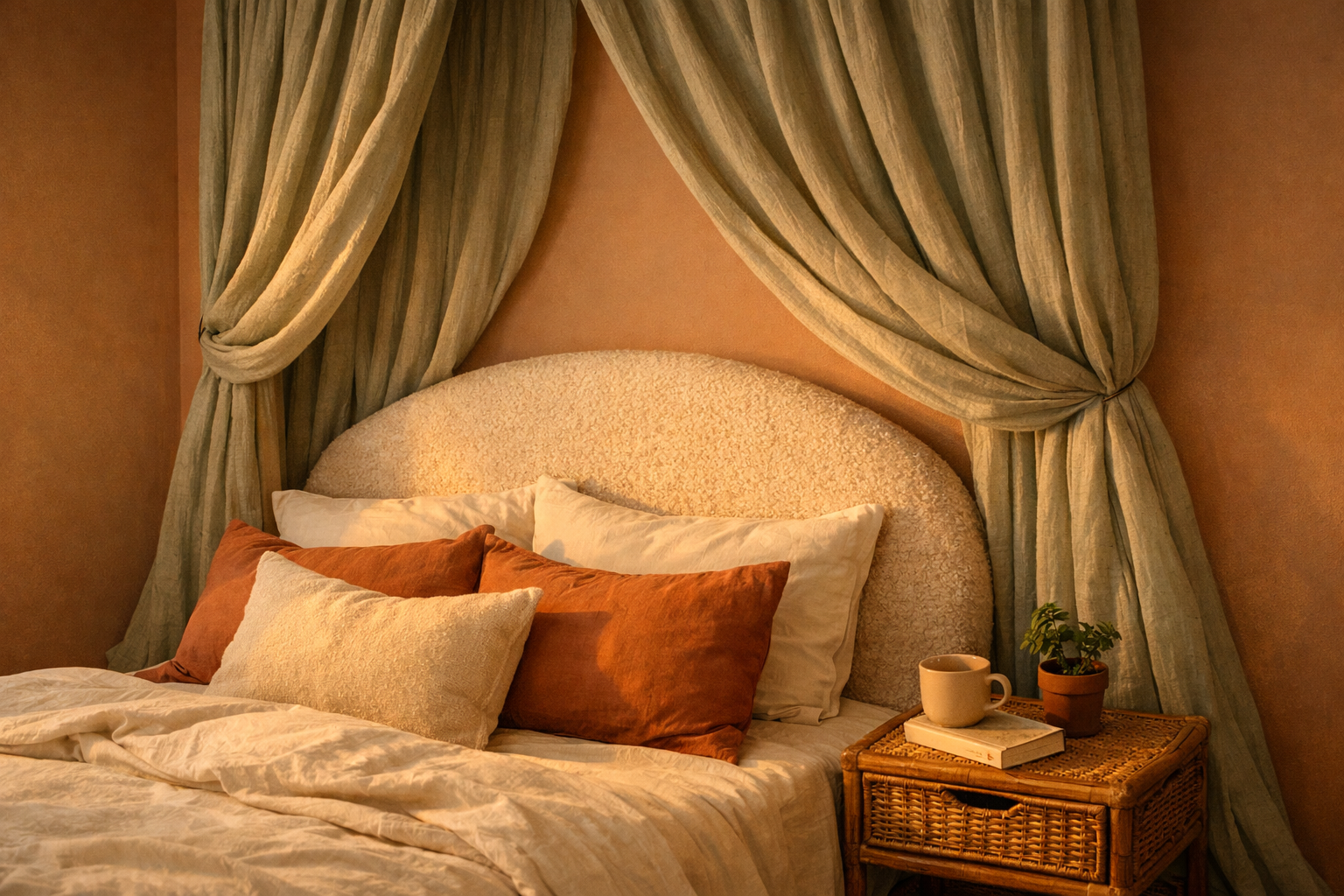
The biggest small bedroom trend I’m obsessed with right now is using curtains as space shapers, not just window coverings. Designers are using draped fabric — heavy linen, velvet, softly patterned textiles — to frame beds, soften corners, and create cozy reading nooks. Think of it like building a little world within your room.
Try this: hang a single floor-length curtain panel on the wall behind your bed, on one side of the headboard. In a dusty sage, warm cream, or terracotta. Let it pool slightly at the floor. Suddenly your bed goes from “a place I sleep” to “a place I retreat to.” The cost? One curtain rod and one panel. The visual payoff? Enormous.

Color Drenching: The Small Room Strategy That Actually Works
If you have a small bedroom and white walls, I have news for you — white might actually be making your room feel smaller, not bigger. Designers say color drenching — giving your ceilings, walls, and even furniture the same tonal treatment — reduces visual noise and creates a cocooning, intimate effect that makes a compact room feel intentional rather than cramped.
You don’t have to go dark. Terracotta, ochre, muted sage greens, and sandy neutrals are all having a major moment— and they work especially well in smaller spaces because they make the room feel warm and complete rather than unfinished. Paint your walls, your trim, and even your built-in shelves the same shade. The effect is subtle but transformative.

Furniture That Has a Personality (Not a Matching Set)
In 2026, bedroom design is moving away from matching furniture sets — every piece coming from the same collection — and toward rooms that feel collected, personal, and full of character. This is actually great news if you’re on a budget or working with a small space, because it means mixing pieces.
A rattan nightstand next to a sculptural curved headboard. A vintage wooden stool used as a side table. A boucle accent chair tucked into the corner you usually ignore. Curved and sculptural bed frames with rounded headboards are particularly popular right now — they add softness to a room without taking up any extra square footage.
The rule of thumb: pick one statement piece (usually the headboard or a chair), keep everything else simple, and let texture do the heavy lifting instead of color.

The “Second Zone” That Changes Everything
Here’s the upgrade that separates a bedroom you sleep in from one you actually love: give it a second purpose that’s just for you. In 2026, designers are leaning into subtle zoning — creating a small area for reading, journaling, or just sitting that’s separate from the bed.
This doesn’t require extra square footage. A compact armchair angled toward a window. A small floor lamp beside it. A low side table with a candle and your current book. That’s it. That’s the whole thing. But psychologically, it changes your relationship with the room entirely — suddenly it’s not just where you fall asleep, it’s where you choose to be.
That little reading nook by the window — an armchair, a floor lamp, natural light pouring in — is the kind of detail that makes you actually linger on slow mornings instead of rushing out the door.

The Bottom Line
Your bedroom is the one room in your home that exists entirely for you. Not for guests. Not for productivity. Not for anyone scrolling past it on Instagram.
The most beautiful bedrooms in 2026 aren’t the most expensive ones — they’re the ones that feel like a deep exhale the moment you walk in. That feeling comes from curtains that frame instead of cover, colors that wrap instead of open up, furniture that tells a story instead of matching a catalog, and one small corner that exists purely for the joy of being in your own space.
Start with one change this weekend. Just one. And watch how differently you feel about the room you’ve been sleeping in all along.
🛏️ Ready to actually do this?
Download the Cozy Bedroom Styling Checklist — your step-by-step guide to a cozy renter bedroom.
Get it here →
Leave a Reply