This post contains affiliate links. If you purchase through my links, I may earn a small commission at no extra cost to you. Thank you for supporting Cozy Room Ideas!
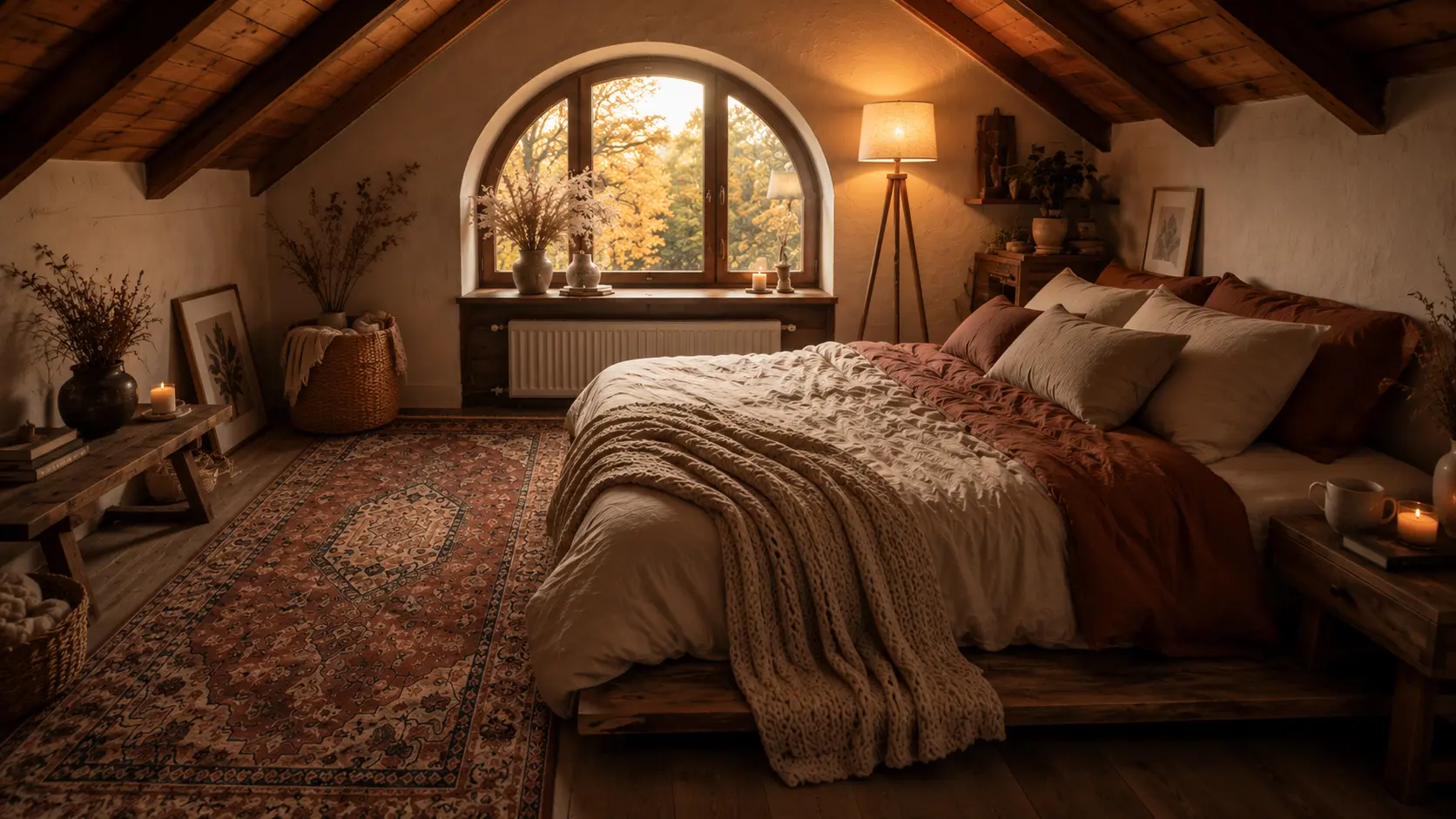
The attic bedroom is the room everyone gets stuck with — the one at the top of the stairs with the ceiling that slopes down on both sides and the wall that’s only full height for about three feet. Most people spend years fighting it. They push furniture against the tall wall, hang things too high, and then wonder why the room never feels finished. Here’s the thing: they’re solving the wrong problem. The slope isn’t what’s making the room feel wrong. It’s the furniture scale, the lighting, and the absence of texture. Fix those three things, and that awkward attic room becomes the coziest one in the apartment.
Start With the Bed — and Go Lower Than You Think
The biggest visual mistake in an attic bedroom is treating the ceiling like a problem to work around. The slope doesn’t need to be hidden. It needs to be leaned into. And the fastest way to do that is with a low bed.
A tall headboard in a sloped-ceiling room does one thing: it draws the eye straight to where the ceiling starts cutting in. It makes the architecture look like it’s closing in on the furniture. A low bed — or no headboard at all — lets the slope breathe. The eye moves across the room instead of snagging on a collision between furniture and ceiling.
The second thing the bed needs is bedding that looks lived in rather than hotel-crisp. In a room with character — raw wood, sloped ceiling, uneven proportions — perfectly pressed white bedding looks wrong in a specific way. It looks temporary. Like nobody actually sleeps here. Washed, rumpled, slightly imperfect bedding in warm oat or rust tones does the opposite. It makes the room look like it was designed to feel this way.
A washed cotton duvet cover in a warm neutral is the move here. The slightly crinkled texture reads as intentional softness, not laziness. Layer it with a pillow in a complementary terracotta and you’ve built a bed that anchors the entire room — without a single piece of furniture above shoulder height.

Cozy Attic Bedroom Lighting: Stop Using the Ceiling
Overhead lighting is the reason most attic bedrooms feel like a place to store boxes rather than a place to sleep. It hits from above, casts flat light across every surface, and makes the slope of the ceiling look like a structural flaw rather than an architectural feature.
The fix is not complicated. Turn off the overhead light and put one warm lamp in the corner where the ceiling is lowest.
This is counterintuitive — most people avoid putting things near the low part of the ceiling because it feels like it’ll make the space seem smaller. It does the opposite. A warm light source in the lowest corner creates a glow that pulls the eye down and in, making the room feel intimate instead of cramped. The slope stops being a limitation and starts being the reason the room feels like a hideaway.
💡 The low-corner rule In a sloped-ceiling room, warm light placed at the lowest point makes the architecture feel like a design choice. The eye stops reading the slope as a defect and starts reading it as enclosure — which is exactly the feeling a cozy bedroom needs.
A tall floor lamp works better than a table lamp here because it fills more of the vertical space without needing wall height to do it. The OUTON wood tripod floor lamp is the specific one worth getting — wood tripod base, beige linen shade, dimmable with four color temperature settings. Place it in the corner where the ceiling drops, set it to the warmest temperature, dim it to about 40%, and the room changes entirely. No installation. No landlord conversation. One lamp placement.
You don’t need a new bedroom. You need to stop using that overhead light.
Cozy Attic Bedroom Walls: Work With the Slope, Not Against It
Most people hang things on the only full-height wall and leave the sloped sections bare. The result is a room that feels lopsided — one wall doing all the visual work while the rest of the space looks unfinished.
The angled wall doesn’t want a framed print hung at eye level. That’s a flat-wall solution forced onto a surface it doesn’t suit. What works on a sloped wall is something organic, draped, or low-hung — something that accepts the angle instead of fighting it.
A macramé wall hanging is the right answer here. Not because it’s trendy, but because it works with the physics of the wall. A textile piece hung from a low point on the slope sits naturally against the surface rather than sticking out at an awkward angle. It adds warmth, breaks up the blankness, and — importantly — doesn’t require a single nail in a load-bearing wall. A removable adhesive strip handles it.
This macramé wall hanging in warm neutrals is sized to sit in the mid-section of a sloped wall without overwhelming the space. Hang it lower than you think — about halfway down the slope — and it reads as intentional rather than like it was placed wherever a nail happened to be.


Want the complete room checklist so nothing gets missed?
The Cozy Bedroom Styling Checklist walks you through every layer — bed, light, walls, floor, and finishing details — so the room actually feels done when you’re finished. Designed for renters. No renovation required.
The Rug: Define an Odd-Shaped Floor
Attic floors are almost always irregular — a narrow run along the longest wall, maybe an awkward L-shape where the stairs cut in. A rug doesn’t just add warmth here. It does the spatial work of making the floor feel like it was planned.
The key is running it along the longest axis of the room rather than trying to center it under furniture. In a standard bedroom, centering a rug under the bed makes sense. In an attic, centering a rug often means it ends up split awkwardly between the full-height section and the sloped section, looking like it doesn’t know where it belongs. Run it lengthwise. Let it follow the room’s natural logic.
Tone matters too. A pale rug in a low-light attic room disappears. A rug in warm terracotta, rust, or aged red does the opposite — it becomes the color anchor the whole room arranges itself around. The KUTA Vintage Accent Rug works for this exact reason: the distressed pattern reads as collected-over-time rather than just purchased, and the warm tones hold up under the low amber light without going muddy.
If you’re working with a longer, narrower attic floor, a runner layered over a larger neutral base rug is an option worth considering — I wrote about that layering approach in detail in this post on bedroom rug layering.
💡 Renter note None of these pieces require installation, drilling, or landlord approval. The floor lamp plugs in. The wall hanging uses adhesive strips. The rug lays flat. Every layer here is fully reversible.
The Last Layer: What Makes a Cozy Attic Bedroom Feel Finished
There’s a specific difference between a room that looks styled and a room that looks like someone actually lives in it. The first kind has everything in the right place. The second kind has one thing slightly out of place — and that imperfection is exactly what makes it feel real.
In an attic bedroom, the finishing layer is texture. Not more furniture. Not more wall art. Texture.
A chunky knit throw draped at the foot of the bed does more visual work than almost any other single piece in the room. It adds dimension to the bed without changing the color story. It photographs well. And it reads as the kind of thing that ended up there naturally — not placed, just left. That’s the quality you’re going for in a room with this much architectural character. Everything slightly earned, nothing too perfect.
For the windowsill or nightstand, the Mitt&Ditt ceramic flower vase — short, round, handcrafted weathered terracotta — closes the loop on the material story the rest of the room is telling. Raw wood ceiling. Woven textile. Washed cotton. Distressed rug. A matte clay vase is the last sentence in that language.

Shop This Cozy Attic Bedroom Look
If I were starting today, I’d get the floor lamp and the duvet cover first. Those two changes — the light and the bed — do more for an attic bedroom than everything else combined. The rest follows naturally once those two are in place.

Shop This Attic Bedroom Look
Start with the duvet cover and the floor lamp. Those two changes solve most attic bedroom problems immediately. Add the wall hanging, define the floor with the rug, then finish with the throw and vase.
Washed Cotton
Duvet Cover
The rumpled texture softens the architecture and makes the room feel lived-in instead of temporary. This is where the attic bedroom starts.
Wood Tripod
Floor Lamp
Placed in the lowest corner, this creates the warm glow that turns an awkward attic into a quiet retreat instead of a spare room.
Macramé Wall
Hanging
Soft texture works naturally on angled walls. Hang it lower than instinct suggests and the slope suddenly feels intentional.
Vintage Accent
Rug
Warm terracotta tones anchor the room and help odd-shaped attic floors feel intentional rather than awkward.
Chunky Knit
Throw
Draped loosely at the foot of the bed, this adds the texture that makes the room feel collected rather than assembled.
Terracotta
Ceramic Vase
The small detail that ties together the wood, textiles, and warm earthy tones running through the entire room.
Before you close this tab — the checklist that keeps it all from unraveling
Every room gets to a point where you’ve bought the things but the room still doesn’t feel right. The Cozy Bedroom Styling Checklist is built for exactly that moment — a layer-by-layer guide that makes sure nothing was skipped and everything lands.
Leave a Reply