This post contains affiliate links. If you purchase through my links, I may earn a small commission at no extra cost to you. Thank you for supporting Cozy Room Ideas!
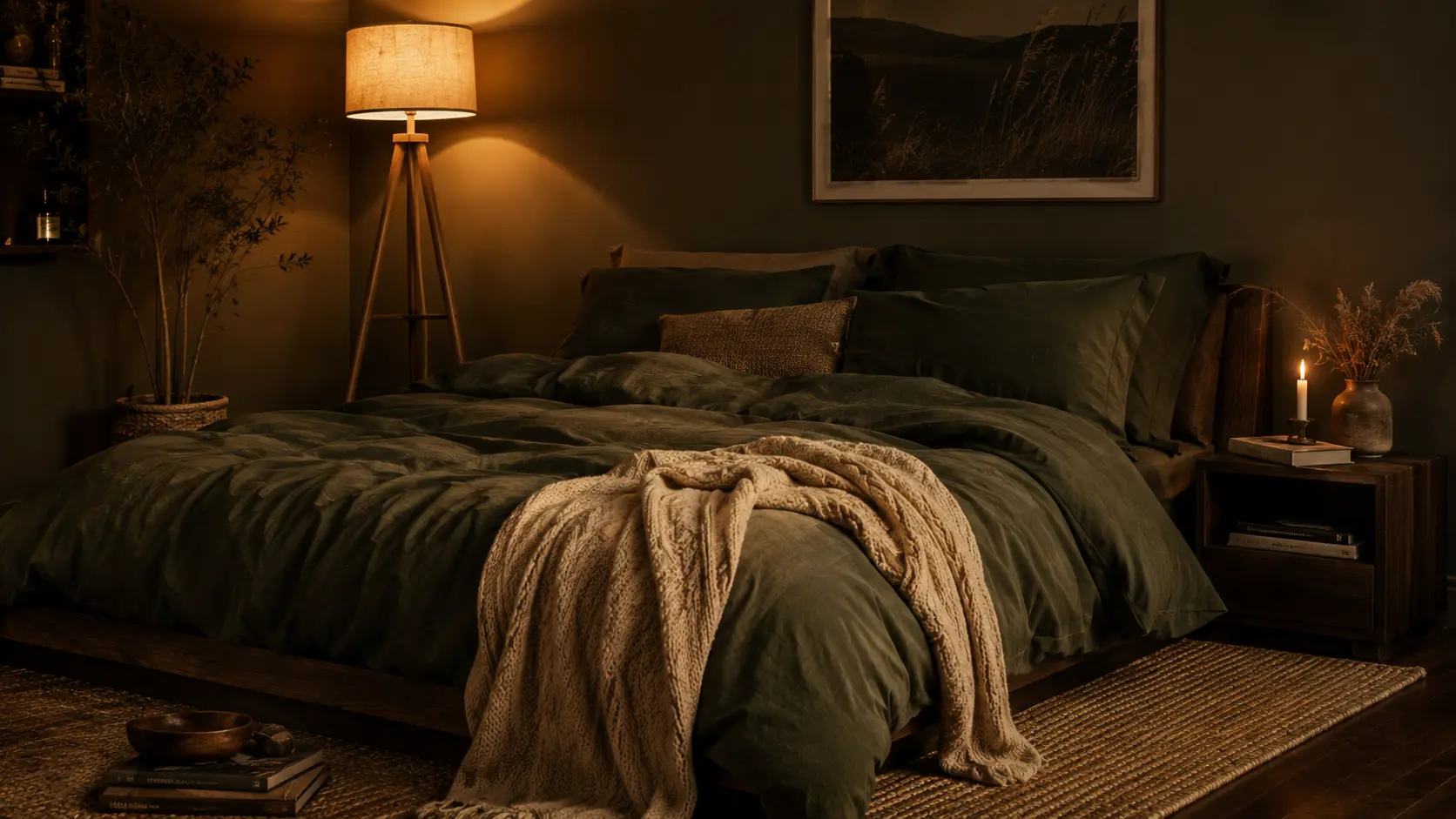
Single lamp in the corner. Dark olive bedding — visible texture, slightly rumpled. A jute rug, a throw at the foot of the bed, nothing bright or sharp-edged anywhere in the room. You’ve seen versions of this bedroom on Pinterest probably a hundred times. You’ve saved it. You’ve felt something when you saw it. And then you bought something beige — because dark felt like a risk, a commitment, something that required certainty you didn’t have. This post is about why that room isn’t any of those things, and exactly what it takes to build it.
None of this requires paint. The reason dark bedrooms look the way they do in the rooms you’ve been saving has nothing to do with the walls — and everything to do with the materials on the bed, the floor, and the corner where the lamp sits.
Why Most Cozy Dark Bedroom Ideas Don’t Actually Feel Cozy
Most attempts at a dark bedroom end the same way. You buy darker bedding. The room feels heavier than you wanted, colder than you expected. You assume you went too dark, pull back, and land somewhere in the middle — still not the room you wanted, just a dimmer version of the one you already had.
The shade of color isn’t the problem. The surface it’s on is.
💡 Why dark rooms go wrong Dark velvet, washed linen, and woven natural fiber absorb light softly — which is exactly what makes them read as warm. The same dark shade on smooth surfaces — polyester, thin cotton, glossy finishes — bounces light back flat and reads as cold. Two bedrooms with identical color palettes can feel completely different. One has texture. One doesn’t.
The rooms you’ve been saving aren’t just dark. They’re textured. The darkness is the backdrop — the texture is what makes it feel like something. Every surface in those images is doing something with light: absorbing it, diffusing it, creating soft shadows across woven and crinkled material. That’s not a design secret. It’s material selection. And it’s the only thing standing between a heavy bedroom and a warm one.
Two bedrooms with identical color palettes can feel completely different. One has texture. One doesn’t.

The Bedding Choice That Sets the Tone for the Whole Room
Here’s what a rental bedroom looks like before you do anything: a bed that takes up most of the floor, covered in whatever duvet you’ve had since you moved in. Maybe it’s white. Maybe pale grey. The color is probably fine. The problem is it looks temporary — smooth, flat, like something that came with the apartment. You can style the nightstand, add a lamp, put things around it — and the bed still reads as a placeholder. Everything orbits it and nothing lands.
The bed is the anchor. What you put on it determines whether the room reads as designed or assembled. In a dark bedroom especially, the bedding does more work than anything else — it sets the palette, establishes the texture, and tells the eye where the room lives before anything else registers.
The MooMee 100% Washed Cotton Duvet Cover in Solid Olive Green is the piece this post is built around. The washed cotton has a linen-like texture — visibly crinkled, fully matte, nothing smooth about it. In warm light, the olive green reads as rich and earthy rather than stark. It absorbs light rather than reflecting it, which is precisely the material behavior that separates warm dark rooms from cold ones. The bed stops looking like a rental bed. It starts looking like someone’s bed — a specific someone who made a specific choice. Start here before buying anything else.

The Lamp That Makes a Cozy Dark Bedroom Feel Like Rest, Not Just Dim
You’ve changed the bedding. The room looks different. Something still feels off — the darkness isn’t enveloping, it’s just less bright. The overhead light is still on, or there’s one lamp working too hard from the wrong position. It doesn’t feel like the room you saved. It feels like the same room with a different duvet.
Dark bedrooms that actually feel like rest have one thing in common: the light source is warm, singular, and positioned low. Not overhead. Not blue-white. Amber-toned, diffused, placed at or below eye level — on a nightstand, in a corner, near the floor. The editorial rooms you’ve been saving almost always have multiple warm sources at different heights. The single most effective change you can make is adding one warm lamp to a corner that currently has nothing in it.
If overhead light is still the dominant source in your bedroom, I wrote about exactly why it’s the starting problem — and the specific swap that fixes it — in this post. The short version: overhead light flattens every surface in the room and makes even good materials look wrong. In a dark bedroom, it turns warm into clinical before anything else gets a chance.
The OUTON Wood Tripod Floor Lamp is the corner piece. Warm wood base, fabric shade that diffuses rather than projects light, tall enough to cast warmth across the upper half of the room without competing with the bed. Swap in a 2700K warm white bulb — that specific color temperature is what creates the amber-toned pool of light you’ve been trying to recreate. One lamp, one corner. The room stops being a bedroom with the lights turned down and starts feeling like somewhere deliberately designed to feel exactly the way it does.


Stop waking up in a bedroom that doesn’t feel like yours
If you’ve been saving dark bedroom pins for months and your room still looks exactly the same, the Cozy Bedroom Styling Checklist is the step you’ve been skipping — a clear sequence for what to change first, second, and third, so nothing you buy feels wasted.
The Rug Rule for Cozy Dark Bedroom Ideas That Hold Together
Three decisions, in order. Get these right and the floor stops being the part of the room that makes everything else look unresolved.
Material first. In a dark bedroom, the rug needs to be natural fiber — jute, wool, or woven cotton. The same rule from the bedding section applies at floor level: natural fiber absorbs light softly and adds a layer of warmth that polyester and synthetic weaves cannot replicate. A rug that looks warm in a product photo can read as flat and cold in the actual room if the material is wrong.
Tone second. The rug does not need to be dark. A natural-toned jute rug in a dark bedroom does more work than a dark rug would — the contrast gives the eye somewhere to rest. A room where every surface is equally dark reads as flat, closed off. One warmer, lighter note at floor level is what makes the rest of the darkness read as intentional rather than overwhelming.
Size third. Err bigger. The rug needs to extend at least 18 to 24 inches past the sides of the bed. If it only fits under the feet, the bed floats and the room shrinks. The nuLOOM Rigo Jute Rug in Natural is handwoven, natural fiber, and comes in a full range of bedroom sizes — the 6×9 fits most queen setups, 8×10 for a king or a larger room.
💡 The contrast principle A natural jute rug works better in a dark bedroom than a dark rug because contrast gives the eye somewhere to land. When every layer — bedding, walls, lamp — is deep-toned, one warmer surface at floor level stops the room reading as a single heavy block and makes it read as a layered, intentional space.

The Finishing Layer That Makes It Feel Styled, Not Just Dark
The bedding, the lamp, the rug. At this point the room already looks different. This last layer is the difference between a room that looks like you bought some dark things and hoped for the best, and a room that looks like someone made a series of deliberate, connected choices.
One throw. Draped loosely at the foot of the bed — not folded, not centered. In a color lighter than the duvet: beige, oatmeal, warm cream. This is the same contrast note the rug plays on the floor, now happening at bed level. The Longhui Chunky Cable Knit Throw in Beige is 100% organic cotton with exactly the kind of visible cable knit texture that reads warm against dark bedding. Drape it slightly off-center and leave it slightly imperfect — that’s what makes it look like a room someone actually uses.

Then the nightstand: one candle, or one dried botanical stem in a small ceramic vessel — not a collection, not a styled corner. One element with organic texture, positioned where the lamp light lands. The point isn’t decoration. It’s giving the light somewhere to fall that feels inhabited rather than blank.

The natural materials logic running through all of this — washed cotton, jute, organic cotton knit — is the same principle that makes a farmhouse-influenced bedroom feel lived-in and warm. If you’re building toward that direction alongside or instead of a darker palette, the cozy farmhouse bedroom guide covers how natural texture works across a warmer, lighter version of the same layering approach.

Shop This Dark Bedroom Look
Start with the olive duvet. Add the lamp second. Ground everything with the jute rug. Finish with the throw. Four decisions, in order, and the room you’ve been saving starts looking achievable instead of aspirational.
Olive Washed
Cotton Duvet
The foundation piece. The washed cotton texture absorbs warm light beautifully and gives the bed the depth that makes dark bedrooms feel warm instead of heavy.
Wood Tripod
Floor Lamp
Creates the amber glow that makes dark bedrooms feel restful instead of dim. One warm corner changes how every texture in the room reads.
Natural Jute
Area Rug
The lighter layer that keeps the room from feeling heavy. Natural texture underfoot gives the eye somewhere to rest while grounding the bed.
Chunky Cable
Knit Throw
The warm beige contrast that breaks up the darker bedding and adds the final layer of softness that makes the room feel finished.
The room you’ve been saving is closer than you think
The Cozy Bedroom Styling Checklist gives you a clear order of operations — what to change first, what to skip, and how to avoid buying things that don’t move the room forward. For a dark bedroom or any bedroom that still doesn’t feel right.
Leave a Reply