Disclosure: This post contains affiliate links. If you buy through them, I may earn a small commission at no extra cost to you. I only recommend products I’d genuinely put in my own space.
Bedrooms with no built-in closet photograph better. Not by accident — scroll Pinterest for ten minutes and count how many of the rooms that make you stop use some form of visible, open storage. The answer is most of them. This post is about why. And about the five-move system that turns a no-closet bedroom from something you apologize for into something you’d actually photograph.
Small Bedroom, No Closet: Why That Might Be Your Room’s Greatest Advantage
Here is what a built-in closet gives you: a door. Usually a sliding door in a builder-beige finish, or a louvered panel that hasn’t been fashionable since the early 2000s. It occupies an entire wall. It closes flat. It contributes nothing to how the room looks, nothing to how it feels, nothing to what it says about who lives there.
Here is what a bedroom with no built-in closet has instead: an entire wall that has to become something. That constraint — the one you’ve been apologizing for, managing around, quietly resenting — is exactly what forces the room into being more specific, more personal, more visually interesting than a room with a plain sliding door could ever be.
The bedrooms that stop people mid-scroll on Pinterest almost always have at least one element of visible, open storage. Not because the designer ran out of closet space. Because open storage done right is the most personal surface in a bedroom. It shows exactly who lives there. A plain door doesn’t do that.
There is a version of this that looks like a dorm room. There is a version that looks designed. The difference isn’t the rack, the budget, or even the clothes. The difference is five specific decisions — which is what the rest of this post covers.
If you’ve already tried covering the storage with a curtain and it looked worse, you weren’t wrong to try — curtains can absolutely work as a room feature in a small bedroom — but that approach works best when the goal is softness on a wall, not hiding something. Here, the rack doesn’t get hidden. It gets made into the point.
The Garment Rail That Makes Small Bedroom No Closet Solutions Actually Work
Most garment racks look cheap for one reason: metal. The chrome or matte-black pipe rack was built for function. It holds clothes and that is the entirety of its ambition. In a bedroom, it reads exactly like what it is — equipment. And equipment in a living space always looks temporary, even when it’s been standing in the same corner for two years. You walk past it every morning and your eye catches it the same way it catches a box you haven’t unpacked yet. Not offensive. Just unresolved. A low-grade signal that the room isn’t finished.
The switch that changes the entire reading of the room is material. A solid wood or rattan-framed rail doesn’t read as storage equipment — it reads as furniture. Natural material connects it to a warm, earthy bedroom instead of sitting apart from it like an object that wandered in from a stockroom. And furniture, unlike equipment, belongs in a room. It doesn’t need to be explained.

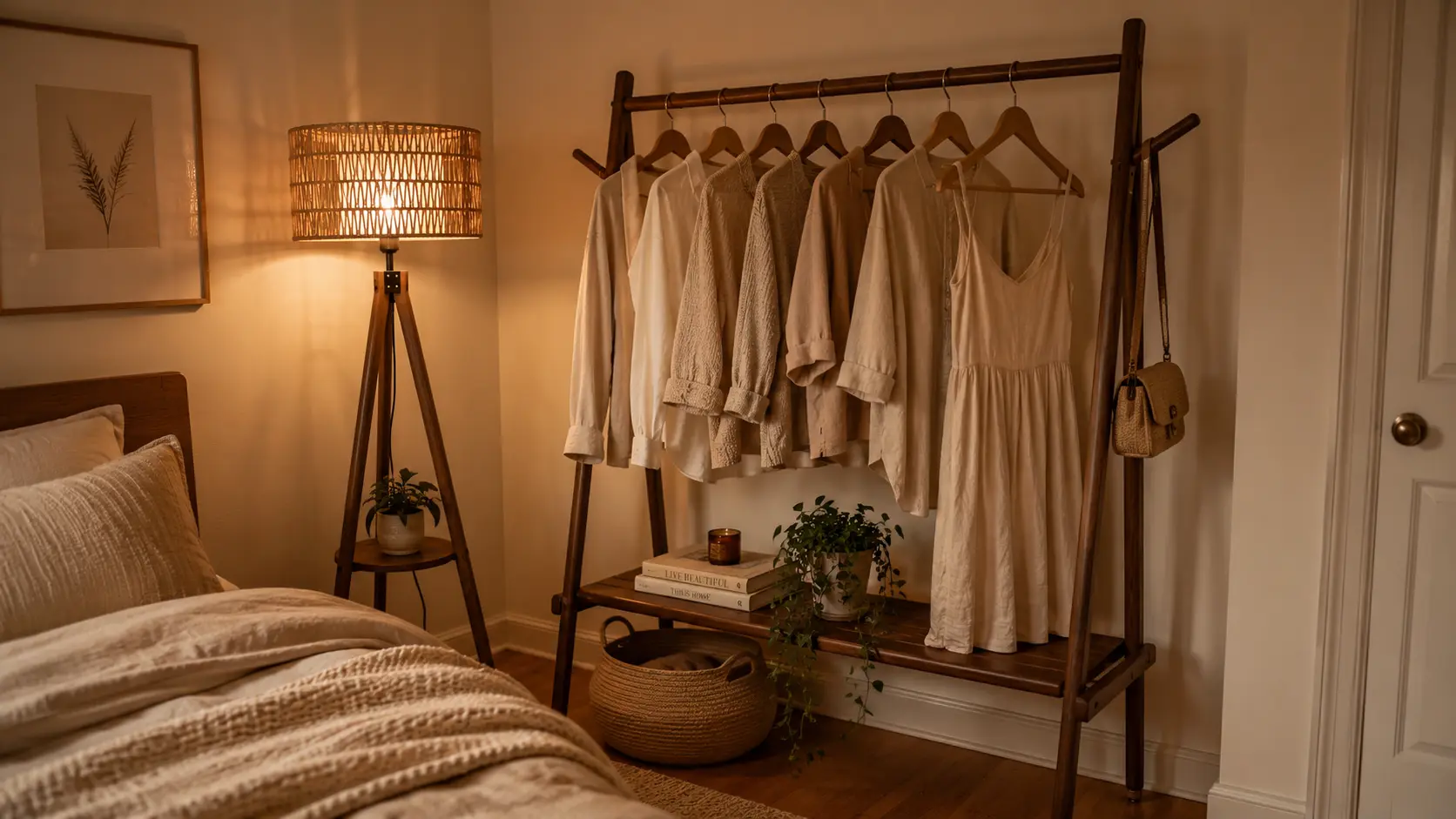
The Muwuele Solid Wood Clothing Rack in Walnut is built to function as furniture, not storage hardware. The A-frame rubberwood construction gives it the visual stability of a dresser — it stands the way a piece of furniture stands, with presence and intention rather than utility. The lower shelf is what separates it from bare-legged racks that float awkwardly above the floor: it creates a natural landing zone for a basket, gives the piece a finished bottom edge, and makes the rack look complete rather than like something that arrived without all its parts. The walnut finish sits comfortably alongside warm wood floors, rattan accents, and natural linen — the material language of a bedroom that feels settled rather than assembled.
What to avoid: multi-tiered bamboo racks with shelving filling every level. They look like a closet organizer that escaped into the room. The rack in this system holds your edited wardrobe — not everything you own. One hanging bar. One lower shelf. Deliberately empty space. The restraint is the point.
💡 A garment rack made from natural materials doesn’t read as storage in a bedroom — it reads as furniture. That single change, material rather than organization, is what separates the rack that embarrasses you from the one that defines the room.
The One Edit That Makes a Clothes Rail Look Curated
Here is the single most important thing you can do for a garment rail in a bedroom. It costs nothing. It takes twenty minutes. And it has nothing to do with the rail itself.
Edit the colors on it.
A rack with varied prints, mixed colors, and mismatched fabrics reads as chaos regardless of how tidy it is. You can fold everything perfectly, organize by category, buy matching hangers — and it will still look like a pile of clothes on a bar. The problem is not organization. The problem is color noise.
Edit what’s visible down to a single palette: earthy neutrals, warm creams, natural linens, soft whites, warm tans. Everything else goes somewhere else — a drawer, a bin, under the bed if you have to. What remains on the visible rail should look like a curated capsule, not a closet that ran out of space. The same rack. The same clothes. The only thing that changed is what you chose to put on display.

This is the edit that makes someone look at a bedroom photo and say “is that a clothing installation?” instead of “why is there a clothes rack in the bedroom?” It’s the difference between a rack that reads as styled and one that reads as tolerated — and it requires no new purchases, no rearranging, no expertise. Just the discipline to put the non-neutral pieces somewhere they’re not on display.
The hangers matter here, but not as the main event. Inconsistency — plastic in three colors, wire from the dry cleaner, a mix of styles — adds to the exact visual noise the color edit is trying to eliminate. The Amber Home Natural Wooden Coat Hangers (30-pack, Natural finish) do one specific job: they disappear into the palette rather than competing with it. The warm natural wood becomes part of the material story. Hangers that are a distraction become hangers that are invisible.
A clothes rail styled in earthy neutrals doesn’t look like storage. It looks like a curated installation. The palette does the work — not the rack.
The Vignette Formula: Three Things That Go Beside the Rail
Picture a garment rail against a wall. Just the rail — nothing else. Now picture the same rail with a warm floor lamp beside it, casting amber light upward along the hanging clothes. A round jute basket sitting at floor level below the shelf. A small plant resting on that shelf.
The rail didn’t change. The room did.
This is the vignette formula: one light source, one grounding element below, one surface element at shelf height. Three additions that turn a piece of functional storage into a deliberate corner of the room. Remove any one of them and the rack goes back to looking like a rack.

The light is the most important element. Without it, the rack is just clothes on a bar, lit by whatever the overhead fixture is doing — and overhead light is the reason most bedrooms never feel settled regardless of what else is in them. It flattens everything it touches. It illuminates the rack from above and all directions at once, which means nothing has shadow, nothing has depth, nothing looks like anything except a storage situation. Add a warm lamp beside the rack — one that casts light at body level, not ceiling level — and the entire corner shifts. The clothes become part of the atmosphere instead of just hanging there. The rack becomes a corner worth looking at.
The LAMSU Boho Rattan Floor Lamp in Brown does this exactly right. The hand-woven rattan shade doesn’t deliver the sharp pool of light a fabric drum shade produces — it diffuses warmth softly, with texture, creating a glow that makes everything near it look considered. The walnut wooden tripod base sits in the same tonal family as the Muwuele rack’s walnut finish. Placed beside the rail, these two pieces don’t read as separate purchases arranged together. They read as a corner that was designed.
The grounding element below is what keeps the rack from looking like it could be moved at any moment. A bare floor beneath a garment rack — legs, floor, nothing else — makes the whole piece feel provisional. The Goodpick Wicker Storage Basket in Jute placed below the shelf anchors the rack the way a rug anchors a bed. It gives the piece a settled base. It also solves a practical problem — somewhere to land shoes, folded items, or anything that doesn’t hang. At ten inches across, it fits cleanly below the lower shelf without spilling out into the room. The round shape and natural jute repeat the organic, earthy tone of the wood and rattan without copying them exactly. The materials are in conversation. That’s what makes a vignette feel designed rather than collected.

How the Rest of the Room Plays Along
The styled storage wall only works if the rest of the room speaks the same language. The rack is walnut. The lamp is rattan and walnut. The basket is jute. Everything in the corner is earthy, warm, and natural — and the room around it needs to support that, not contradict it.
If the bed across the room is dressed in a bright printed duvet, chrome bedside lamps, and a cool grey rug, the storage wall will look like it arrived from a different apartment. Not because the rack is wrong — because the room is speaking two different palettes at once. The eye can’t settle. Nothing feels decided.
The floor is the fastest way to pull the room into alignment. A natural fiber rug repeats the organic material story that the rack already established, without adding pattern, color, or anything that competes for attention. It’s the background that makes everything else look more considered.

The nuLOOM Rigo Jute Hand Woven Area Rug in Natural is the rug for this room. Flat-woven jute in a solid natural tone — no pattern, no border, no color contrast. It connects the floor to the material palette without introducing a new visual element that the room then has to absorb. For most small bedrooms, the 5′ x 8′ is the right size: large enough to anchor the bed and reach toward the rack’s side of the room, not so large it fights the floor for attention. If the room is very tight, the 4′ x 6′ covers the essential ground beneath the bed without overwhelming the space. Either way, what the rug brings is continuity — and continuity is what makes a room feel like it was thought through rather than furnished one piece at a time.

For the bed, the same palette logic applies: washed linen or cotton in natural, cream, oat, or warm sand. Not matching, not matchy-matchy — but in the same tonal family as what’s hanging on the rack. The four-layer bedding formula works especially well here — it builds the kind of settled warmth that makes the open storage wall feel like a choice rather than a constraint.
The Weekend Setup
You don’t need to do all of this at once.
Start with the color edit. Pull everything off the rack that isn’t in the earthy-neutral-warm family. Put it in a drawer, a bin, anywhere it’s not on display. What’s left should hang with deliberate space between each piece. This costs nothing and takes twenty minutes. The rack will look different immediately — not because anything changed structurally, but because the color noise is gone and the palette can finally be read.
Then the basket, below the shelf at floor level. Then the lamp, placed beside the rack on whichever side has more floor space. Switch it on in the evening before you turn on the overhead. Notice what happens to the room.
The rug comes last. It’s the largest investment and the easiest to add once the rest of the palette is confirmed. But by the time the first three moves are in place, the room will have already shifted. That wall you used to angle photos to avoid will have started to become the reason someone asks you where you got your bedroom inspo.
A bedroom with no built-in closet doesn’t need one. It needs five decisions made in the right order. You just made them.
Shop This Look
Start with the Muwuele clothing rack — it’s the piece the entire system is built around. The lamp and basket complete the vignette. The hangers and rug bring the rest of the room into the same material language.
Muwuele Solid Wood
Clothing Rack
A-frame rubberwood in Walnut. One hanging bar, one lower shelf. The piece that makes open storage read as furniture instead of equipment — and changes how the entire wall reads.
LAMSU Boho
Rattan Floor Lamp
Hand-woven rattan shade on a walnut tripod base. A storage corner with nothing beside it reads as storage. This lamp beside the rack is what makes it read as a room instead.
Goodpick Wicker
Storage Basket
Round, jute, 10 inches across. Sits below the rack shelf and gives the corner a finished bottom edge. Without it, the rack floats. With it, the corner lands.
Amber Home Natural
Wooden Coat Hangers
30-pack, Natural wood finish. Mismatched hangers cancel out the palette no matter how well the clothes are edited. Matching natural-wood hangers across the full rail make the whole thing read as intentional.
nuLOOM Rigo Jute
Hand Woven Area Rug
Natural, flat-woven jute, solid tone. No pattern, no border. Connects the floor to the room’s material palette without introducing a new visual element the space has to absorb. 5′×8′ for most small bedrooms.
Leave a Reply