This post contains affiliate links. If you purchase through my links, I may earn a small commission at no extra cost to you. Thank you for supporting Cozy Room Ideas!
The problem with your small bedroom probably isn’t the size.
You’ve tried things. Maybe a new lamp, a rug that was supposed to feel grounding, different bedding. Each decision helped a little — the room improved and then returned to the same underlying feeling. Not obviously wrong. Just never quite right. A something off that you can’t name, which is more frustrating than something clearly broken.
Almost every small bedroom layout decision — where the rug sits, where the lamp lives, whether the corner across from the bed ever gets used for anything real — traces back to one decision that was made before the decorating started and never revisited: which wall the bed is against. That one placement either opens the room or collapses it. Get it right and everything else clicks. Get it wrong and the room keeps returning to the same unresolved feeling no matter what you add.
Why Your Small Bedroom Never Feels Right (And It’s Not the Size)
You moved in and put the bed where it made sense. Against the long wall because that’s where most beds go. Against the wall with the outlet because the lamp had to plug in somewhere. The decision took a few minutes and felt reasonable. You haven’t questioned it since.
But the room has felt slightly wrong ever since too.
Not dramatically wrong — the kind of wrong that shows up as a floor that looks proportionally strange, a corner that’s been empty for months with vague plans attached to it, and a bed that looks like it’s sitting in the room rather than belonging to it. You’ve bought things meant to fix the feeling. Each one helped a little. The feeling came back.

The specific kind of off in a small bedroom with a layout problem is almost always a proportion issue, not a square footage issue. The room reads as a rectangle that got divided by the bed instead of organized around it. That’s a layout problem. Layout problems don’t respond to decor solutions — they respond to one thing.
The One Test That Reveals the Right Bed Wall
Most people assume the right bed wall is the longest one. It isn’t.
Stand in your bedroom doorway and look in. The right wall — for the bed — is whichever one, when the bed is against it, gives you the longest unobstructed sightline from where you’re standing. That sightline is the whole thing.
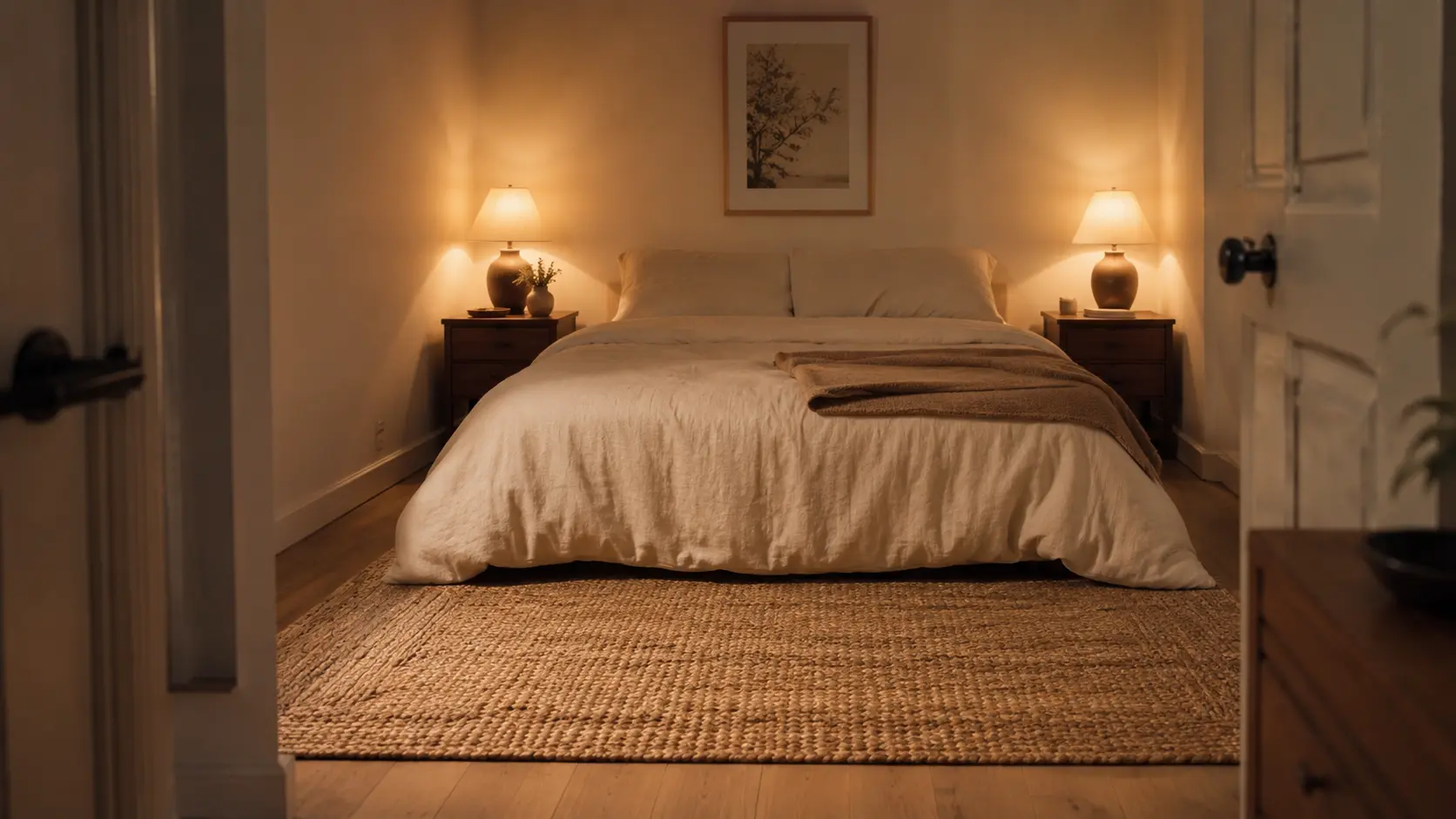
A small bedroom that feels larger than it is almost always has this in common: you can see across the full depth of the room the moment you walk in. The bed reads as a focal point at the far end. The floor, the rug, and the space of the room itself are visible in front of it. The room appears to have depth.
A bedroom on the wrong wall gives you the opposite. You walk in and immediately hit the side of a mattress. Your eye stops there. The room reads as a box cut in half, and there’s no visual depth to find — regardless of how beautiful the bedding is, regardless of how well-chosen the lamp. The styling isn’t the problem. The sightline is.
The test for the right bed wall has nothing to do with which wall is longest. It’s about which placement gives you the longest unobstructed sightline from the doorway.
💡 The doorway test Stand in your bedroom doorway and look in. The right bed wall is whichever one — when the bed is against it — lets your eye travel the full length of the room before hitting the side of a mattress. In most small bedrooms, this is the wall directly opposite the doorway. A bed placed there makes the room feel deeper. A bed against either side wall cuts the depth in half.
To test it without moving anything: stand in your doorway now. Does your eye travel across the short width of the room first, or down the full length? If it’s the width — if the first thing you see is the side of the bed — the bed is probably on the wrong wall.
In most small bedrooms, the wall that passes this test is the wall directly opposite the doorway: headboard against the far wall, foot of the bed facing the doorway as you walk in. This is the layout interior designers default to in small rooms — not because it’s a formula, but because it’s the only arrangement where the room can show its full depth. The lighting in your room reads differently too once the bed is on the right wall — the lamp on each nightstand can reach both sides of the bed equally instead of one side being tight against the wall.

What Breaks in a Small Bedroom When the Bed Is on the Wrong Wall
Wrong bed placement doesn’t just make the room feel smaller. It creates a cascade of problems that look like decor issues and aren’t.
The rug loses its anchor. When the bed is against a side wall, the rug runs parallel to the length of the room instead of sitting beneath the bed as its base. It reads as a stripe across the floor rather than a grounding element. The bed looks like it’s sitting on top of the rug instead of held by it. You can read every guide on rug layering and bedroom rug sizing — if the bed is on the wrong wall, the rug problem is upstream.
💡 Why the rug never looks right A bedroom rug that runs parallel to the bed — instead of beneath it — will always feel off, even in the right size and the right material. The rug’s job is to ground the bed, not extend from it. Wrong bed wall means wrong rug position, which means the floor never comes together no matter what you buy.
The corner goes dead. A bed against a side wall almost always puts one corner directly beside the headboard — too tight to use for anything. The corner across from the bed, which could be a second zone in the space, ends up disconnected from the rest of the room. It becomes the corner that collects things: a chair nobody sits in, a box from the last move, a plant that’s just occupying space.
The lighting gets uneven. A side-wall layout creates asymmetric nightstand space — one side of the bed sits in open floor, the other is tight against the wall. The constrained side often can’t hold a proper lamp. The room ends up lit from one side only, which flattens every texture and leaves half the space slightly underlit no matter what lamp you buy for the open side. If your bedroom lighting has always felt like it’s working against the room, check which wall the bed is on before you blame the fixture.
How Everything Else Falls Into Place Once the Bed Is Right
Move the bed to the wall that passes the doorway test and watch what happens to the decisions that have been difficult.
The first one to resolve is the rug.

With the bed correctly positioned — headboard on the far wall, foot facing the doorway — the rug belongs under the lower two-thirds of the bed. It extends at least 18 to 24 inches on each side of the mattress, and past the foot of the bed far enough that you step onto it when you get up. In most small rooms with a full or queen, a 5×8 positioned with its short end toward the headboard wall is the right size.
Sizing matters as much as placement. A rug one size too small in this position still doesn’t anchor the bed — it reads as a mat under the foot rather than a base the whole bed sits in. Get the size right before getting the style right.
What makes natural jute right here is what it doesn’t do. It doesn’t add color. It doesn’t compete with the bedding, the lamp, or the nightstand. It adds texture and material warmth — the kind that reads as weight from across the room and as slight roughness underfoot when you’re in it — in a way that makes the space feel inhabited rather than assembled. Bare floors make even a carefully chosen bed look like it’s floating in nothing. The jute rug fixes that specifically: the bed stops sitting in the room and starts belonging to it.
The nuLOOM Rigo Jute Hand Woven Area Rug in Natural in 5×8 is the right starting size for most small bedrooms with a full or queen. If your floor space allows it, the 8×10 extends the grounding effect further — the anchor gets stronger as the rug gets closer to filling the visible floor. No installation, no pad required. Renter-safe on every surface.

The nightstand situation resolves too. With the bed on the far wall, both sides of the headboard have equal floor space. Two nightstands, two lamps, balanced light from both sides. The room achieves symmetry without you engineering it.
Stop decorating around a room that was never set up right
The Cozy Bedroom Styling Checklist walks you through the exact sequence — from placement to product to finishing detail — so every decision lands in the right order. No more adding things hoping one of them fixes the underlying feeling.
The Corner You’re Wasting (And the One Move That Fixes It)
With the bed repositioned, look at the corner diagonally across from the headboard. It’s probably the most open floor space in the room — and almost certainly the most underused.
Most people leave it empty, put a plant there that never commits, or treat it as overflow storage. None of those activate the corner. They just fill it without purpose.
A floor lamp here does something that no other change in the room can replicate: it creates a second light zone. Your bedside lamps light the sleeping area. A warm lamp in the corner throws ambient light across from the bed, which makes the room feel wider and deeper at the same time. Your eye has two destinations instead of one — and a small room with two light zones always reads as larger than a small room with one. This is the same principle behind any good bedroom reading corner — the light creates the zone even when the furniture doesn’t.

The rattan-shade floor lamp in walnut works in a tight corner specifically because the footprint is contained — the walnut tripod legs don’t spread across the room — while the rattan shade is large enough to cast real ambient warmth rather than a narrow reading beam. The Brown walnut base and rattan shade bring material depth to a corner that was previously just air. It stops being a gap in the room and becomes an anchor.
The LAMSU Boho Tripod Floor Lamps Rattan Wood Floor Lamp in Brown doesn’t need installation, ceiling work, or a landlord conversation. It stands in the corner, plugs in, and the room has a second zone by the time the bulb warms up.

If you’ve been living with a room that ends at the bed — where everything happens in one zone and the rest of the floor is dead space — this is what changes that. Not a renovation. One lamp, one corner.
What to Do If You Can’t Move the Bed
Some bedrooms genuinely constrain the layout. A radiator on the optimal wall. A closet door that swings into the path the bed would occupy. A door placement that leaves only one workable wall and the ideal wall isn’t it. These are real constraints, and the honest answer is that they limit what’s achievable — but they don’t eliminate the options.
If the bed has to stay on a compromise wall, the work shifts from placement to compensation.
The rug needs to be larger. On a side-wall layout where the rug can’t sit cleanly beneath the lower two-thirds of the bed, go one size up from what you’d normally choose. The added coverage compensates for a position that’s working against it. A 5×8 room calls for an 8×10.
The corner lamp becomes more important, not less. On a side-wall layout, the constrained nightstand situation means the corner opposite the bed becomes the room’s best available ambient light source. The second zone the floor lamp creates matters even more when the bedside table on one side barely has room for a lamp at all.
The nightstand height is worth checking before you buy anything new. The surface should be within two inches of the top of your mattress — not lower, not higher. Any lower and the lamp casts light upward toward the ceiling instead of horizontally into the room, which flattens everything. Any higher and it reads as detached from the bed. In the constrained-side position — where the nightstand is doing the work of two — this alignment makes a visible difference.
The Apicizon Nightstand with 2 Storage Drawers in Natural — wood-leg frame, fabric drawers in a quiet Natural finish — sits at the right height for most standard mattress depths and keeps whatever accumulates on the constrained side of the bed organized without adding visual weight. Works on any wall. No tools required.

Shop This Small Bedroom Layout
Start with the jute rug — it’s the first thing to place once the bed is on the right wall, and the product that confirms the proportions are working. The floor lamp activates the corner. The nightstand handles everything the constrained side of the bed has been missing.
nuLOOM Rigo
Jute Rug
Natural jute in the 5×8 size — extends past both sides of the mattress and past the foot of the bed. This is what makes the bed look like it belongs in the room instead of sitting in it. The texture adds material warmth the floor alone can’t provide, and the Natural color sits quietly beneath whatever bedding you already have.
LAMSU Boho
Tripod Lamp
Walnut tripod base, large rattan shade, Brown finish. Small footprint for a tight corner, but the shade is large enough to throw real ambient warmth across the room. Creates a second light zone that makes a small bedroom feel wider than it is. Plugs in — no installation, no ceiling work.
Apicizon
Nightstand
Wood-leg frame with fabric drawers in Natural. Sits at the right height for most standard mattress depths so the lamp on top casts light horizontally into the room instead of upward. Two drawers handle what usually ends up on the floor beside the bed. Works cleanly on any wall.

The reason small bedroom layouts feel impossible to fix isn’t that they’re too small. It’s that the one decision that would actually work — moving the bed — feels like a project, so it never gets revisited. Instead she adds things, each one chosen carefully, and the room improves slightly and returns to the same underlying state.
The bed wall is the decision that was made before decorating started. Revisit it. The rug goes where it always should have gone. The corner finds a purpose. The room stops working against itself.
One move. Everything else follows.
If you’ve been saving bedroom ideas for months and the room still looks the same — this is what actually moves you forward
The Cozy Bedroom Styling Checklist gives you the exact sequence: placement first, anchor piece second, layers after. So you stop adding things in the wrong order and start seeing results that actually stick.
Leave a Reply