Disclosure: This post contains affiliate links. If you buy through them, I may earn a small commission at no extra cost to you. I only recommend products I’d genuinely put in my own space.
The reason your studio apartment feels like one big room has nothing to do with square footage. It doesn’t need a curtain divider, a bookshelf wall, or more furniture. It needs two rugs — placed specifically, with a gap between them that does exactly what a wall would do.
You know the feeling. You’ve arranged the furniture, found a rug that works, added a lamp that actually warms the space. And still — when you step back and look at the whole thing — it reads as one room where sleeping happens in one corner and sitting happens in another. Nothing defines the boundary. Everything floats in the same open space, and the apartment just never settles.
That’s a floor plane problem, not a furniture problem. And once you understand what’s actually creating the one-room feeling, the fix is more specific — and more affordable — than anything you’ve probably been considering.
Why Your Studio Apartment Decor Feels Like One Big Room

Apartments with separate rooms don’t need any help defining zones. The wall between the bedroom and the living room does all the work — your brain reads the structure and experiences both spaces as genuinely different places. A studio doesn’t have that. The kitchen, the sleeping area, the seating area — all sharing the same floor, the same ceiling, the same unbroken walls. Your brain has no structural signal to separate them, so it doesn’t.
Most people respond by adding vertical elements: a tall bookshelf as a fake wall, a room divider screen, a curtain rod stretched across the ceiling. These solutions almost always make a studio feel smaller without actually solving the problem, because they fight against the open-plan space rather than working with it. And they rarely create the zone separation they promise — because the floor underneath is still one continuous surface.
Your brain doesn’t divide space based on furniture arrangement or vertical objects. It divides space based on floor transitions. When the floor changes — in material, in visual boundary, in clearly marked zone — your brain registers a separation. That’s why a single rug under a sofa makes the seating area feel like a defined space even in a completely open room. The floor changed. The zone registered. A studio with two separate, distinct floor changes has two rooms — regardless of how many walls it has.
The Two-Rug Rule (and Why the Gap Is the Point)
So the fix is not a second wall. It’s a second floor change.
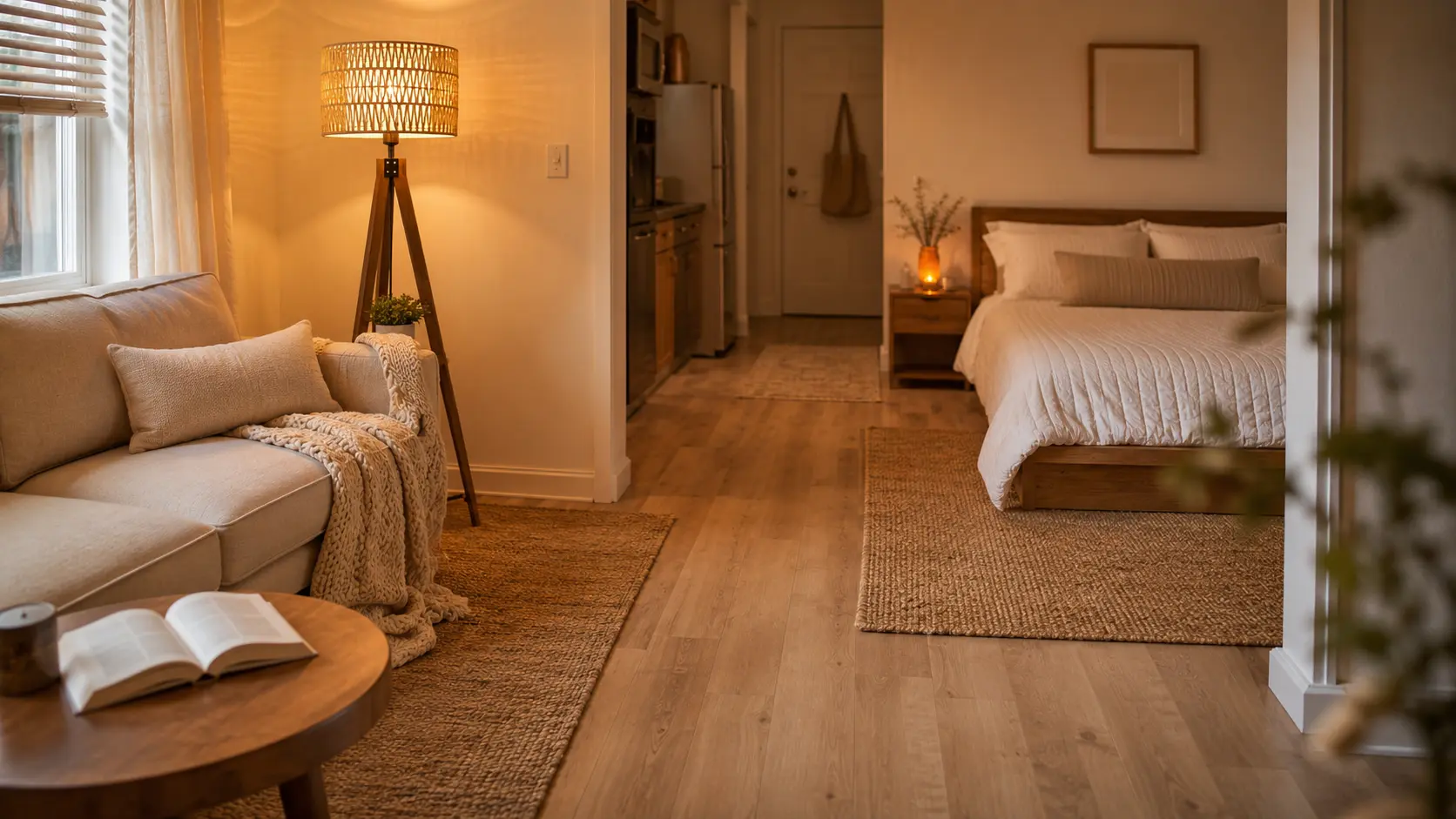
One rug anchors your seating zone. A second rug — the same size, the same material — anchors your sleeping zone. Between them: a strip of bare floor. That strip is the most important element in the whole arrangement, because that gap is what your brain reads as the dividing line between two rooms. Not the rugs themselves. The gap.

This is what most people miss. If you push two rugs together so their edges touch, you’ve created one very large floor zone. The spaces merge. One room. The moment you leave a visible gap between them — eighteen to twenty-four inches of bare floor between the two rug edges — your brain registers a threshold. The seating area becomes a room. The sleeping area becomes a room. Same square footage. Two spaces.
The nuLOOM Rigo Jute Hand Woven Area Rug in Natural does this with exactly the right visual weight. Jute flat-weave reads as floor rather than statement piece — and that’s precisely what a zone anchor needs to be. Quiet enough to define the space without competing with everything above it. The 5×8 size covers both zones correctly: wide enough to take the front legs of the sofa and the full coffee table for the seating zone, and to extend visibly on three sides of the bed for the sleeping zone. You’ll want two — both the same size, same color, same link. (Both lift and reposition easily if you rearrange.)
Two rugs that touch create one zone. The gap between them is the wall.
💡 Why the gap works Your brain doesn’t need a physical wall to register a spatial boundary — it needs a visual one. A strip of bare floor between two rugs is enough. The gap reads as a threshold, the same way a doorway does. Both zones feel entered rather than just walked through.
If you’re working through the broader question of how to make your apartment feel intentional before any textiles are in place, the apartment decorating guide here covers the anchor-first sequencing problem that trips up most open-plan spaces.
How to Choose Two Rugs for Your Studio Apartment
The first question most people ask when they hear “same rug twice” is: won’t that look strange? It doesn’t — and understanding why is the key to making this method work.
The rugs need to be visually quiet to function as floor planes rather than decorating moments. If the two rugs are different patterns, different textures, or mismatched sizes, the eye reads them as objects rather than zones — and that’s the wrong signal. You want the rugs to almost dissolve into the floor, present enough to define the space but not so visually loud they become the room’s subject. Using the same rug means the floor is consistent. The zones are defined by what’s on each rug — the sofa and lamp in the seating zone, the bed and nightstand in the sleeping zone. The rugs are the foundation, not the feature.

Seating zone placement: Front two legs of the sofa on the rug, back two legs on bare floor. Coffee table sits fully on the rug. This pulls the sofa and table into one defined cluster — the seating zone reads as a unit rather than two floating pieces of furniture that happen to be near each other.
Sleeping zone placement: The rug goes under the lower two-thirds of the bed — foot end and both sides visible, headboard end on bare floor. When you step out of bed in the morning, you land on the rug. That sensory transition from bare floor to woven jute is the moment the sleeping zone confirms itself as a finished, considered space.

For more on how jute works as a base layer and what to put on top of it in the sleeping zone, the small bedroom rug layering guide covers the same base-layer logic for both a dedicated bedroom and a studio sleeping zone.
Light Pools: The Second Layer of Zone Separation
The two rugs define the zones at floor level. A floor lamp reinforces them from above — and this is where the studio starts to feel genuinely like two spaces rather than a clever arrangement of furniture in one room.
A floor lamp in the seating zone doesn’t just provide light. After dark, it creates a pool of warm light that makes the seating zone feel enclosed. Everything inside the pool — the sofa, the coffee table, the rug — becomes its own world. Everything outside the pool softens into peripheral warmth and distance. It’s the same open room. But the lamp turns the seating zone into somewhere — a place you move toward rather than a corner you sit in.
Placement is what determines whether this works. Position the lamp behind or to the side of the sofa — not in front, where it competes with the sightline. The goal is light that falls down into the zone rather than casting a beam across the whole studio. Place it at the back corner of the sofa, on the far side from the sleeping zone, and the light pools entirely in the seating area. The sleeping side stays in soft, separate darkness. Two atmospheres in one room.

The LAMSU Boho Tripod Floor Lamp in Brown is the right choice for this. The walnut wood tripod holds its visual weight without dominating the zone, and the hand-woven rattan shade diffuses light downward and outward into the seating area rather than throwing a single bright beam across the room. It’s plug-in only — no wiring, no installation conversation required — and it signals, even after dark, exactly where one space ends and another begins.

Making Both Zones Feel Like the Same Home
Two defined zones is the goal. But two zones that feel like they were decorated separately is the mistake that comes right after. You’ll recognize it when you see it: the seating area looks like it belongs to one aesthetic and the sleeping area looks like it belongs to another. The studio feels more fractured than it did before you started — technically correct, but not cohesive.
The fix is a connecting thread. One material, repeated in both zones, is what tells the eye these spaces belong to the same home. Not matching — related. A throw on the sofa that sits in the same earthy palette as the jute rug in both zones. The same lamp warmth throughout. A plant at a similar height in each area. These small repetitions are the difference between a studio that has zones and a studio that feels like one considered space doing two things.
The Chunky Cable Knit Throw Blanket from Longhui bedding in Beige does this quietly. The 100% cotton knit in Beige reads as the same warm earthy palette as the natural jute below — not identical, but clearly from the same material world. Draped over one sofa arm in the seating zone, it echoes the floor layer at eye level and keeps the palette consistent across both zones without requiring you to add anything to the sleeping side to make them feel connected.


The fastest version of everything in this post is one rug, placed correctly. Not both zones at once, not the lamp, not the throw — just one 5×8 jute rug dropped under the front legs of the sofa with the coffee table sitting on it. The seating zone will register immediately. You’ll feel it before you’ve even looked at the sleeping side of the room. Start there.
Shop the Studio Zone Edit
Start with the rug — you’ll need two, the same one, in the same size. Once the floor is doing its job, the lamp and the throw fall into place.
nuLOOM Rigo
Jute Hand
Woven Area Rug
Natural. 5×8. Jute flat weave. One for the seating zone, one for the sleeping zone — same rug, same size, one link. The quiet floor anchor that makes both zones register.
LAMSU Boho
Tripod Floor
Lamp
Brown. Walnut tripod base, hand-woven rattan shade. Plug-in only. The zone separator that does its best work after dark — warmth where you need it, darkness where you don’t.
Chunky Cable
Knit Throw
Blanket
Beige. 100% cotton knit. The palette thread that ties the seating zone to the rest of the room. Drape over one sofa arm — that’s all it needs.
Leave a Reply