Disclosure: This post contains affiliate links. If you purchase through them, I earn a small commission at no extra cost to you. I only recommend products I’ve vetted and stand behind.
There’s a simple test for whether your bedroom qualifies as a sanctuary. Walk in at 10pm and notice what your body does in the first three seconds. Not what you think — what you feel. Does something soften? Does your chest do that release thing, like you’ve been carrying something all day and the room just took it? Or do you just… arrive. In a room that happens to have a bed in it.
Most bedrooms fail the test. The reason almost never has to do with budget, or apartment size, or taste. It has to do with what the room was actually designed for — and what it wasn’t.
These bedroom sanctuary ideas work on one shared principle: you fix what’s actively breaking the feeling before you add what builds it. The order matters more than the products.
What the 10pm Test Actually Measures
We make almost every decorating decision in daylight. We choose a rug on a Saturday morning. We rearrange furniture in the afternoon. We decide the room looks good, and we stop there.
The problem is that a bedroom isn’t a daylight room. The moment that actually matters — the moment you need it to work — is 10pm. And at 10pm, the overhead light is usually on, shadows are flat, and the room that looked considered at noon looks like it’s waiting for something functional to happen.
A bedroom sanctuary is designed for what the room does at night. That means the lighting, the surfaces, and the objects all have to support one specific signal: this space is for rest. Not for tasks. Not for productivity. Not for tomorrow. For right now, at 10pm, when your body needs the room to confirm what your mind hasn’t let go of yet.
Most people design their bedrooms for how they look during the day, then wonder why they don’t feel right at night. A room optimized for daylight is almost never optimized for 10pm. The test reveals this immediately. Design for the moment that matters, and the daytime version takes care of itself.

The Light Is Lying to You
The fastest way to fail the 10pm test is to turn on an overhead light.
Overhead lighting was designed for tasks: seeing what you’re doing, reading small print, moving safely through a room. It does these things well. What it cannot do is create rest. It casts everything downward, flattens every texture, and illuminates the ceiling — the one surface in your bedroom that contributes exactly nothing to the feeling you’re trying to build. When the overhead goes on, your room stops having a mood and starts being a well-lit room. Those are not the same thing.

The fix isn’t a dimmer. The fix is a lamp placed in the corner, at standing height, that you turn on instead.
What a corner floor lamp does — specifically one with a diffusing shade — is redirect where the light falls. Rather than washing a room from above, it creates a warm pool at eye level and below. The rest of the room goes into soft shadow. And shadow is what makes texture visible. Shadow is what makes washed cotton look like it has depth, what makes a jute rug look like something real and tactile, what makes a room look like somewhere rather than a generic lit space.
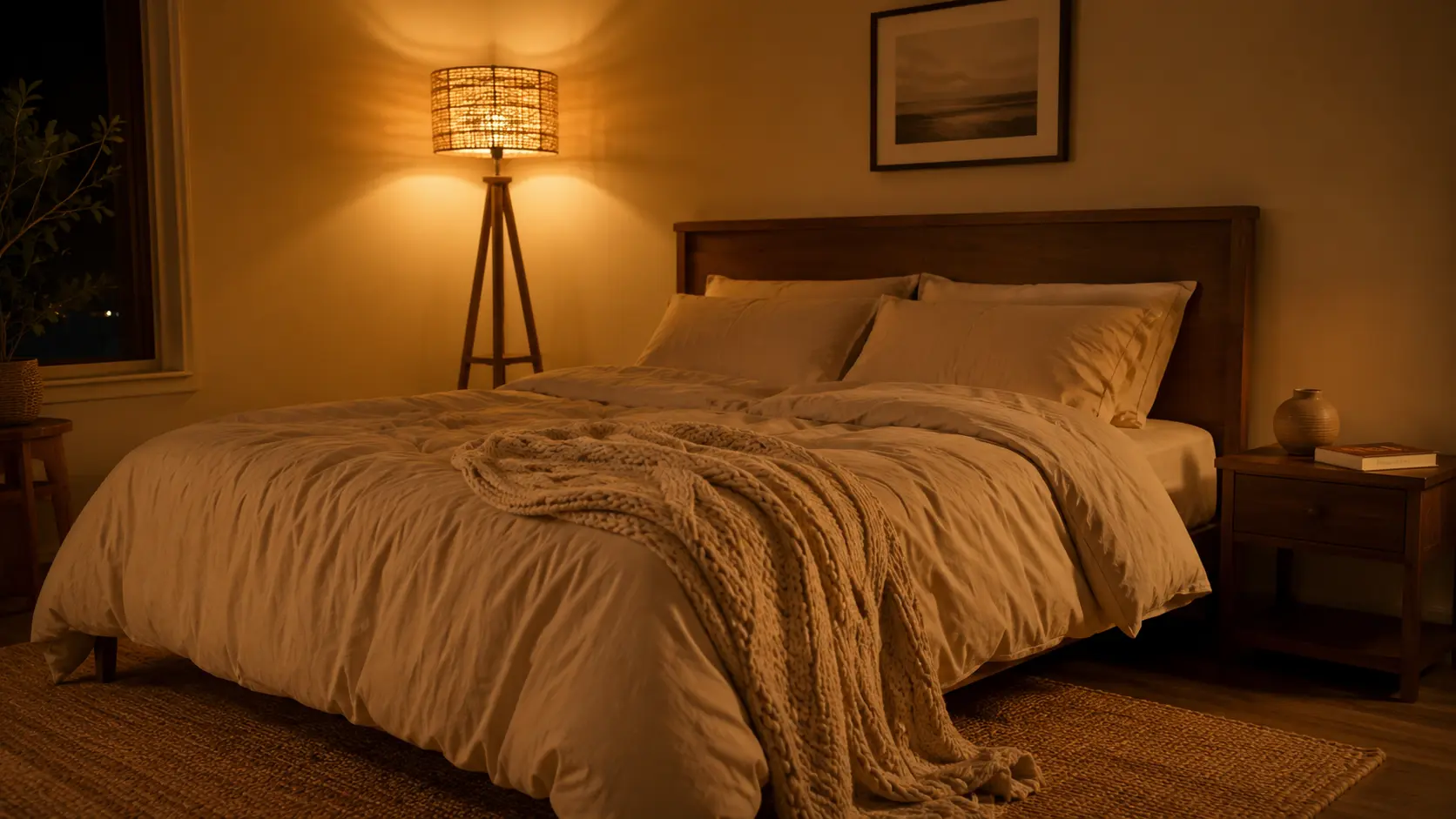
The lamp that does this work: the LAMSU Boho Tripod Floor Lamp. The base is solid walnut — matte finish, not the shiny faux-wood that most budget lamps use. The shade is hand-woven rattan, which doesn’t direct light so much as scatter it: warm amber, diffused, falling softly outward. At 59 inches tall, placed in the corner opposite your bed, the light falls where it should — across bedding, across the rug, across surfaces — not upward where nobody needs it at 10pm.
One lamp. Corner placement. Overhead off. That’s the first thing the 10pm test reveals, and for most bedrooms it’s the highest-impact single change available. If your bedroom has more complex lighting — multiple fixtures, a tricky built-in — this guide on the bedroom lighting fix works through the full sequencing.
What to Remove Before Any Bedroom Sanctuary Can Work
There’s something most bedroom sanctuary guides skip entirely. Something that happens before any lamp or duvet cover can do its job.
Your brain is very good at reading the difference between “rest” and “task.” It does this automatically, before you’ve consciously decided anything: scans the room, identifies objects, assigns each one to a category. A candle reads as rest. A work bag on the floor reads as task. A folded throw reads as rest. A charging cable coiled on the nightstand surface reads — somewhere below conscious thought — as unfinished.
Here’s what this means for your bedroom sanctuary: every object in the room that your brain reads as task actively cancels any rest signal you add on top of it. The candle doesn’t override the laptop. The lamp doesn’t neutralize the bag from yesterday sitting against the wardrobe. The anxiety objects win, quietly, every time — which is why people buy the right products and the room still doesn’t feel like anything. They’ve been building rest on a compromised foundation.

The edit that matters most before you buy anything: get the task objects out of the room. The work laptop. The commute bag. The charger cable on the nightstand — move it to the floor behind the nightstand, out of your visual field entirely. The pile of things on the chair in the corner that you’ll deal with tomorrow. These are not decorating problems. They are category problems. And they cost nothing to solve except the decision to solve them.
If you want to work through the full sensory picture first — the light temperatures, the material mismatches, the specific things that make a room feel assembled rather than considered — this post on cozy bedroom aesthetic ideas names them specifically. Worth reading before you start adding anything.
The rule: if an object in your bedroom signals “I was doing something here” or “I have something to do,” it doesn’t belong in a room that’s supposed to confirm the day is over. Not at 10pm. The sanctuary starts with this edit.
The One Material That Changes How a Bedroom Sanctuary Feels
There’s a difference between a bed that looks cozy and a bed that changes how you feel when you get into it.
Most beds have decorative texture — a throw at the foot, a pillow arrangement, a patterned duvet cover. They photograph well. But the moment you pull the cover back and get in, the decoration disappears. What’s underneath is the same as before the styling: standard cotton, fine, functional.
Sanctuary bedding isn’t about how the bed looks before you’re in it. It’s about the 0.2 seconds after you pull the cover up — when the material settles around you, and the softness of what’s there and the warmth of the room confirm the same thing at the same moment: the day is done.

Washed cotton does this in a way that standard bedding doesn’t. The washing process breaks down the fiber structure without thinning it — what you end up with is fabric that’s already become what most cotton takes years of washing to become: soft in the way that good things get soft when they’ve been used and cared for. First time out of the packaging, it already feels like that.
The piece to start with: the Bedsure 100% Washed Cotton Duvet Cover in Oatmeal. The Oatmeal colorway is exactly the warm-neutral that reads right at 10pm under amber light — not yellow, not grey-beige, but the specific warmth of something natural. 100% washed cotton throughout — not a blend, not cotton-touch polyester. 4.3 stars across 2,154 reviews. When it’s on the bed with the lamp’s light falling across it, the surface texture creates enough shadow depth to make the whole bed look like it belongs in a room someone actually thought about. For more on how to layer a bed so it photographs this well — and feels this specific — this guide on bedroom throw styling works through it in full.

Then the Chunky Cable Knit Throw in Beige — draped across the lower third of the bed, not folded. The cable knit cotton catches light differently than washed cotton: one surface is smooth and matte, the other is dimensional and raised. The contrast is subtle enough not to compete, and distinct enough to give the bed visible depth. That depth is the difference between a bed that looks dressed and one that looks like it was actually considered.
Building the Rest of the Bedroom Sanctuary (In the Right Order)
The lamp is in the corner. The task objects are out. The bedding is handled.
What’s left is the floor — and the floor is the surface that most bedroom sanctuary guides treat as an afterthought, which is interesting, because the 10pm test reveals it immediately. A bare floor under even a thoughtfully styled bed makes the room feel like something is unresolved. The eye reaches the floor and finds nothing, and nothing reads as incomplete — not intentionally empty, just unfinished.
A natural fiber rug solves this without announcing itself. It’s not decorative in the way a patterned rug is decorative. It’s foundational — the layer that makes everything above it look like it was placed there deliberately.

The placement is specific: position the rug so the lower two-thirds of the bed sit on it, with the rug extending 12–18 inches past both sides. From the doorway at 10pm, the bed appears to be sitting in something — a defined zone within the room — rather than floating on bare floor. That’s the functional difference between a rug that grounds a space and one that just decorates it.
The nuLOOM 5×8 Rigo Jute Hand Woven Area Rug in Natural is the rug that works here. Jute, flat woven, natural color — no pattern, no dye, just the material in its own color. 4.2 stars across 26,762 reviews. It doesn’t compete with the bedding or the lamp. It completes them.
After the rug: scent. Not a specific product — just a principle. A candle with a warm, grounding scent (cedar, sandalwood, or amber) in a small ceramic or amber glass jar on the nightstand. The scent is the last signal. The room now has warm light, cleared surfaces, soft bedding, and a grounded floor. The scent confirms, at the level your brain registers before thought, that this is a rest space and not anything else.


The sequence is: lamp first, removal second, bedding third, floor fourth, scent last. Not a product list — an order of operations. Each thing you fix makes the next thing more effective, which is why buying the right products into the wrong room doesn’t work, and why the same products in the right order — with the right things removed first — change what the room feels like in under a week.
The version of your bedroom that passes the 10pm test exists. It doesn’t require a renovation, or a budget you don’t have, or a bigger apartment. It requires being honest about what’s already in the room that shouldn’t be — and then being deliberate, rather than hopeful, about what you build after. That’s the difference between a bedroom that looks right and one that actually feels like coming home.
Shop This Cozy Sanctuary Bedroom
The lamp is where to start — it’s the one change that shifts how the room feels at 10pm before anything else does. The duvet cover and rug complete the layers that make it stay that way.
LAMSU Boho
Tripod Floor Lamp
The overhead light is what’s keeping your bedroom from feeling like anything. This lamp replaces it — walnut base, hand-woven rattan shade, warm amber diffusion from a corner. Place it opposite the bed and the room shifts before you change a single other thing.
Bedsure Washed
Cotton Duvet Cover
Standard cotton feels fine. Washed cotton feels finished. The 02 – Oatmeal colorway reads warm-neutral under amber light, and the 100% washed cotton has already been softened through — the difference between a bed that looks cozy in a photo and one you actually feel when you get into it.
nuLOOM Rigo
Jute Rug — Natural
A bare floor under a styled bed makes the whole room feel unresolved. Position this 5×8 jute rug so the lower two-thirds of the bed sit on it — from the doorway at 10pm, the bed stops floating and starts belonging.
Chunky Cable
Knit Throw — Beige
Draped across the lower third of the bed — never folded — it adds dimensional texture that flat washed cotton alone doesn’t give you. The contrast between the two materials is subtle and exactly what keeps the bed from looking like it came from a catalog.
Leave a Reply