Disclosure: This post contains affiliate links. If you buy through them, I may earn a small commission at no extra cost to you. I only recommend products I’d genuinely put in my own space.
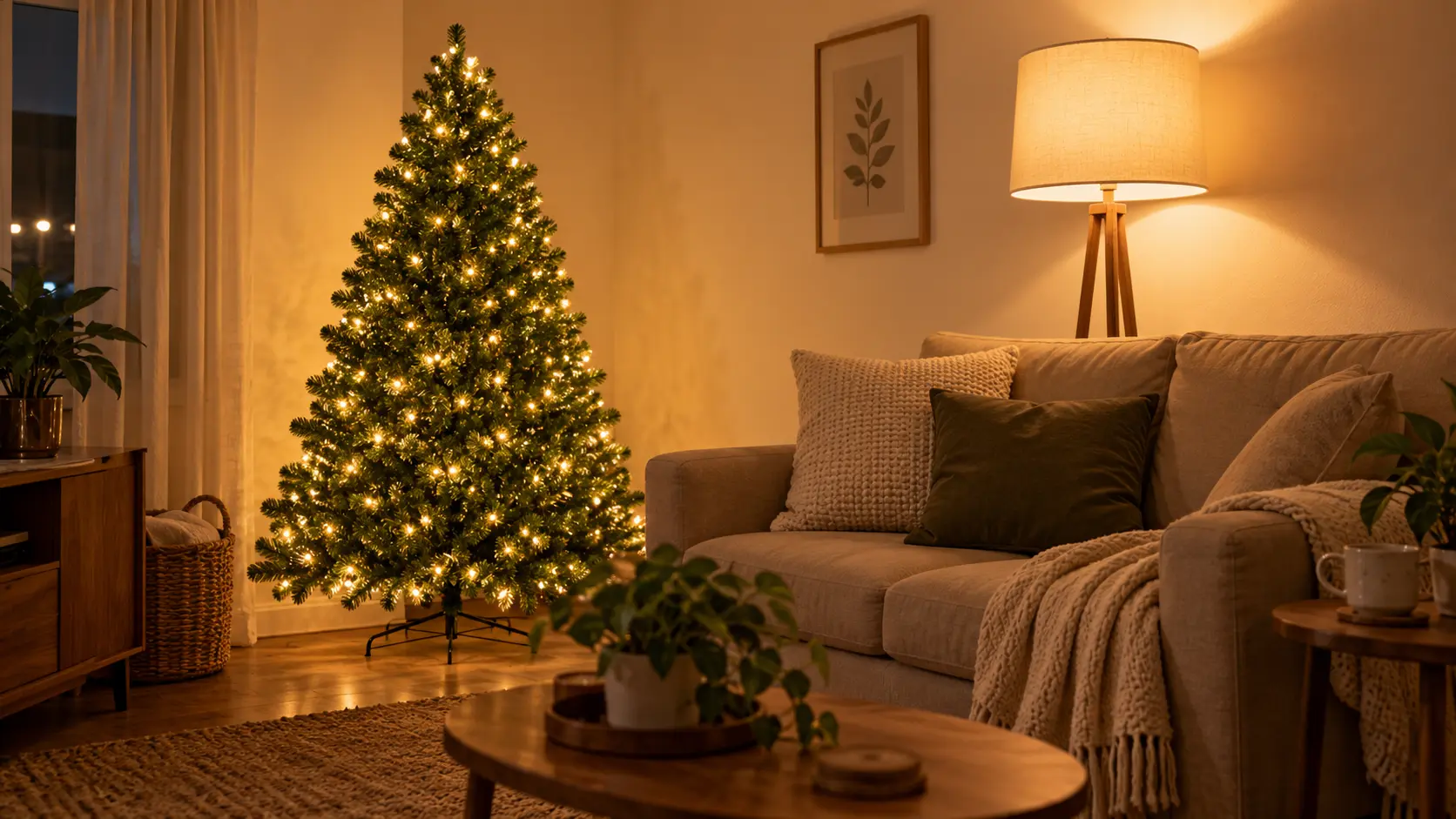
Sarah has had the same 6ft pre-lit Christmas tree for three years. Warm white lights, green branches, perfectly decent. Her living room is cream walls, a sand sofa, blonde floors — rental-standard and quietly nice. Every year she buys a different ornament set. Every year the tree looks assembled. Not wrong. Just assembled.
She’s been saving 2026 Christmas tree inspiration all month. Sage green trees in open-plan lofts. Deep burgundy Heritage Holiday trees in houses with mantels and bay windows. Champagne and crystal arrangements that catch warm light in rooms with 10-foot ceilings. They all look beautiful. None of them look like anything she could recreate in a 520-square-foot apartment with a $150 budget and a pre-lit tree she bought on sale in 2023.
Here’s what those posts don’t say: the trends that look the most expensive in 2026 are built on restraint, not volume. Three ornament types in the right ratio — an anchor piece, a filler, an accent detail — reads as a design decision. A box of ornaments hung all over a tree reads as a box of ornaments hung all over a tree. And restraint, unlike volume, scales down beautifully. Better, sometimes, than a large tree ever could. These are the 7 Christmas tree trends for 2026, each one filtered for the small apartment — with the specific ornament formula that makes it look intentional.
In This Post
✓ The Traditional Green Anti-Trend — the most confident tree choice in 2026, and why simplicity is a decision
✓ Heritage Holiday — the richest-looking trend, built from three ornament types and one craft store trip
✓ Sage & Pearl — the 3-Piece Ornament Formula, and why restraint looks expensive on a small tree
✓ Classic Red & Gold — the one thing that separates a deliberate tree from a pharmacy display
✓ Luxe Noel — the elegant trend that a small neutral apartment pulls off better than a large house
✓ Winter Woodland — the warmest look on this list, and the one that asks nothing of your existing decor
✓ Warm Neutral / Gingerbread — the easiest entry point, done with intention rather than compromise
The Anti-Trend Everyone Is Copying: The Undecorated Green Tree
The biggest Christmas tree trend for 2026 is no trend at all.
After years of white trees, pink trees, gold trees, and every kind of statement made by anything other than green branches and warm white lights, the dominant move this season is a realistic all-green tree left to look like a tree. No maximalist colour bundle. No palette-of-the-year ornamentation. Just deep, genuine spruce green, warm white lights at their lowest glow, and enough space between ornaments that the branches are visible.
It feels counter-intuitive. It works for the same reason restraint always works in design: it reads as a choice rather than a default. Everyone else chased a trend. Choosing not to is its own statement — and a more confident one than most.
If this is the direction: the light colour matters more than most people realise. Warm white LEDs — genuinely warm, not the slightly blue-tinged “warm” on cheaper models — are the single biggest variable between a tree that glows and one that just lights up. The Yaheetech 6ft pre-lit tree uses a true warm white that reads as candlelight from across a room, which is the right reference point. Add ornaments in one finish only — all matte or all slight sheen. Three colours maximum. Use the space between ornaments as intentionally as the ornaments themselves.
The traditional anti-trend asks the room to meet the tree. Cream walls and natural materials will.
Heritage Holiday: The Richest-Looking 2026 Trend — Built From Three Things
Heritage Holiday is the 2026 trend for anyone who has ever felt faintly embarrassed by a Christmas tree that looks too tidy. Deep burgundy ornaments. Forest green branches. Antique gold accents. A few dried botanicals woven through to make the whole thing feel less assembled and more collected — as if the decorations came from different years and different places rather than a single kit bought in October.
That word — collected — is the one to hold onto. A themed tree has ornaments from one matching set. A collected tree has depth: different textures, sizes that aren’t perfectly uniform, one element that doesn’t quite match but somehow makes everything else look more intentional. Heritage Holiday rewards that kind of unevenness. It’s the trend that actually gets better when things aren’t perfectly coordinated.
The way to get there on a rental budget isn’t a curated designer bundle. It’s three categories kept specific:
Heritage Holiday — Ornament Formula
Anchor: 8–10 deep burgundy matte ornament balls in a larger size (80mm) — these set the palette; matte reads richer than sheen at close distance and carries the warmth of the trend
Filler: Small satin forest green balls (40–50mm) spread through the lower two-thirds — builds coverage without competing with the anchors
Accent: 3–4 dried botanical sprigs tucked between branches — cinnamon sticks bundled with twine, pinecone clusters, or dried orange slices from any craft store; this is the element that does the “collected” work

The botanical accent is available at Michaels or any craft chain for a few dollars. The key is tucking rather than hanging — nestled into a branch junction so it looks found rather than placed. One botanical type only. Mixing three natural elements tips collected into cluttered.
Heritage Holiday is one of the more forgiving trends for a neutral base room. Burgundy and forest green read warm against cream walls without competing — Sarah’s apartment would carry this look well, even with the existing sand sofa and blonde floors.
Sage & Pearl: The Trend That Looks Expensive — Here’s the Formula

Sage and pearl is the most talked-about new palette in Christmas decor for 2026, and the most counterintuitive. It doesn’t read as Christmas until it suddenly, completely does. Soft sage green, pearl-tone filler ornaments, ivory accents, a few natural elements in taupe or linen. The overall effect is calmer than any Christmas tree has a right to be — and it reads as intentional in a way that loud, maximalist palettes often don’t.
💡 The ornament type rule The trees that look the most expensive in 2026 have fewer types of ornaments — not fewer ornaments. Three types in the right ratio reads as a design decision. Seven types reads as a box emptied onto a tree.
Sage and pearl proves this. The palette almost demands the three-type structure — add a fourth element and the calm the trend is built on disappears. This is also why it’s the best trend to start with if you’ve never decorated with restraint before. The formula is visible in the result.
The 3-Piece Ornament Formula — Sage & Pearl
Anchor: Shatterproof sage green ornaments in mixed finishes (matte + slight sheen) — the JORNOY 47CT Christmas Tree Ornaments Set in sage green gives three sizes and enough finish variation that you don’t need a second ornament type to create depth
Filler: Ivory or pearl small balls (40mm) spread through the middle section — fills gaps and pulls warm white light in a way the sage green alone won’t
Accent: A natural jute or linen ribbon threaded loosely through the top third — two passes, not a garland; or 3–4 sprigs of dried eucalyptus at even intervals
Apply the formula in order: spread the anchor ornaments across all three levels of the tree first, not clustered at the bottom. Fill visible gaps in the middle section with the pearl filler. Add the accent last — the ribbon or botanical gives the eye something to follow and is what separates a filled tree from a composed one.
This is the trend whose formula was built for Sarah’s apartment. Cream walls and a neutral sofa with warm white pre-lit lights — sage green in that context doesn’t just work, it almost glows. The apartment becomes part of the palette rather than something to work around.
Classic Red & Gold: Why This Is Harder Than It Looks (and the One Thing That Fixes It)

The myth about Classic Red & Gold is that it’s the easy choice — the default Christmas tree that anyone can do. That’s why so many of them look like a seasonal display in a pharmacy: red ball ornaments, gold ball ornaments, repeat. No depth, no texture contrast, no particular reason for the eye to stop anywhere. Recognisable. Forgettable.
Here’s what actually makes this trend land in 2026: a wired velvet-finish ribbon is doing about 60% of the work. Not as a bow at the top. Not as a neat cascading garland. Threaded loosely through the mid-tree branches in large, imperfect loops — so the ribbon surface catches warm light and creates shadows between the ornament clusters. That shadow is the texture contrast every red-and-gold tree without it is missing.
The 3-Piece Formula — Classic Red & Gold
Anchor: 10–12 deep red matte ornament balls in a larger size (80mm) — matte reads richer than sheen at close distance; these set the palette and absorb rather than reflect the warm light
Filler: Smaller gold or champagne balls (40–50mm) spread throughout — builds coverage without competing; the size contrast is what creates visual depth
Accent: The Ribbli red velvet-finish wired ribbon, 2.5 inch threaded in large, loose loops through the middle and upper branches — this is the single element that makes a red-and-gold tree look composed rather than decorated
The ribbon tip that changes the result: thread it before you hang the ornaments, not after. Work from the trunk outward on each pass so the loops have depth and dimension. Imperfect loops are the correct outcome — stiff, symmetrical ribbon reads manufactured; a loose, slightly uneven thread reads considered. The 10-yard length on this ribbon is enough for a 6ft tree with ribbon left over for a wreath or a second pass if needed.
Classic Red & Gold is also the most universally forgiving of the 7 trends in terms of base room palette — cream walls, dark grey, warm beige, all carry it without any adjustment to the formula. There is one room condition that works against it: when the living room already has too many competing warm tones or patterns, the tree becomes another visual object fighting for attention rather than the room’s anchor. If that’s the situation, remove something before you put the first ornament on. A simplified room reads the red-and-gold tree as a deliberate focal point; a busy room reads it as more clutter. The Christmas living room post covers exactly what to clear before you start — the subtraction step most decorating guides skip entirely.
Luxe Noel: The Elegant Trend That Works Best on a Small Tree

Here is the single principle that explains Luxe Noel: the less the room competes with the tree, the more expensive the tree reads. This trend works by putting all its visual weight on the tree itself — champagne ornaments, French blue ribbon as a colour interrupt, crystal-finish accents — and asking everything around it to stay quiet. Which is, not coincidentally, far easier in a small neutral apartment than in a large, furnished house.
A 6ft tree against cream walls with a sand sofa nearby doesn’t fight this palette. The room recedes. The champagne finish under warm white lights reads warmer and more luminous in person than in any product photo — the amber light adds a quality the listing images can never quite capture. The French blue ribbon accent interrupts the monochrome just enough to make the palette feel intentional rather than unfinished.
The 3-Piece Formula — Luxe Noel
Anchor: Shatterproof champagne-finish ornaments in multiple sizes — the BSTDECOR 30ct Champagne Christmas Ornaments come in four sizes from 40mm to 80mm, which creates the natural size variation that gives a 6ft tree depth without requiring a second ornament type
Filler: Clear or crystal-look small balls (40mm) from any brand — background coverage that catches light without colour; this is not the focal point, it fills the middle section so the champagne anchors have space to read
Accent: A French blue wired ribbon, used sparingly — two or three loose passes through the upper third of the tree only; treat it as a colour note, not a garland; the restraint is what makes it read elegant rather than seasonal
This is the trend Sarah chose. Not because it’s the most Christmas of the seven — it arguably isn’t. Because it looked like a decision her apartment could support rather than fight against. And because when she looked at the finished tree, she could see something she’d been trying to produce for three years: three types of ornaments doing what seven had never managed to do.
Winter Woodland: The Warmest Trend — and the One That Asks Nothing of Your Existing Decor
Imagine putting the tree up and realising, for the first time in years, that you don’t have to think about whether your walls are the right colour for the ornaments.
Winter Woodland is the 2026 trend that works with neutral apartments, warm-toned apartments, dark-toned apartments, and everything between. The palette is deep chocolate brown, matte bark texture, natural elements — the colours of a forest floor in January — and it reads as nature rather than Christmas. Nature doesn’t clash with most rooms. It settles into them.
The 3-Piece Formula — Winter Woodland
Anchor: Shatterproof matte brown ornament balls in a large size (3.15 inch) — the Brown Christmas Ball Ornaments Set, Matte in a deep espresso-brown finish builds the forest floor palette; the matte finish is essential here, sheen reads wrong against a natural woodland theme
Filler: Smaller matte cream or oatmeal balls (40mm, any brand) — breaks the single tone, reads as birch bark or winter light filtering through branches
Accent: Pinecone clusters or bundled cinnamon sticks wired to branch junctions — any craft store; use real or dried botanicals rather than plastic versions; the texture difference is visible

The Winter Woodland mistake to avoid: overloading the natural elements. This trend has the most generous range of accent options — pinecones, dried oranges, velvet ribbon, bark-finish ornaments, cinnamon sticks — which is also the reason some woodland trees feel busy rather than collected. One botanical type. Let the matte brown ornaments carry the look; the accent is punctuation, not a second paragraph.
Warm Neutral / Gingerbread: The Easiest 2026 Trend — Not in a Compromising Way
Every year one trend gets dismissed as the safe option. This year it’s the warm neutral palette — cream ornaments, champagne fillers, pearl accents, warm brown details — and the dismissal is unfair.
A warm neutral tree is the one that photographs well in any light, reads as intentional from across a room, and works with the furniture rather than competing with it. It lets the room feel festive without the tree doing all the visual work alone. For a small space, that balance matters.
The 3-Piece Formula — Warm Neutral / Gingerbread
Anchor: Cream or ivory matte ornament balls in a larger size — the tone that anchors the entire palette and reads warm rather than white under warm-light LEDs
Filler: Pearl or champagne small balls spread through the middle section — builds coverage and catches warm white light more softly than silver or metallic alternatives
Accent: A warm brown woven ribbon, or dried botanical clusters in cinnamon and nutmeg tones — a few passes, not a garland; the accent is what distinguishes warm neutral from a tree decorated with whatever was in the box
The Gingerbread variation of this palette adds one more layer: small candy-inspired or iced-sugar-look detail ornaments placed in the mid-section. It reads slightly more playful than the pure neutral version and stays entirely within the same warm range. Both work on a pre-lit warm white tree in a neutral room. This is the best starting point if you’ve never decorated with restraint before — three ornament types, one warm palette, no decisions to second-guess once the formula is set.

Shop These 2026 Christmas Tree Trends
The velvet-finish ribbon is the single product that changes the most trees — start there if you’re only adding one thing this year. Everything else follows the same 3-piece formula across all seven trends.
Ribbli Red
Velvet-Finish
Ribbon
The accent element that separates a deliberate Classic Red & Gold tree from an assembled one. Wired so it holds shape in loose loops. Polyester with a velvet surface on one side — threads through branches cleanly and catches warm light.
BSTDECOR
Champagne
Ornaments
Shatterproof champagne-finish ornaments in four sizes (40mm to 80mm) — the multi-size range does the depth work so you don’t need a second ornament type. Champagne colour confirmed from the listing spec table.
JORNOY 47CT
Sage Green
Ornament Set
47 shatterproof ornaments in sage green across three sizes with matte and sheen finishes mixed — enough variation in one set that you don’t need a second anchor type. The size range from small to 3.15 inch creates natural depth on a 6ft tree.
Brown Matte
Ball Ornaments,
3.15 in
Shatterproof ornament balls in a deep espresso-brown matte finish — the matte surface is what makes this read as woodland rather than metallic. Pairs with cream filler and one botanical accent from a craft store to complete the formula.
The tree Sarah has is probably fine. The way she’s been decorating it is the part worth revisiting — and the revisit is simpler than three years of different ornament sets have suggested.
Three types of ornaments. One anchor, one filler, one accent. The rest is the space between them — and in a 6ft tree in a small apartment, that space isn’t a limitation. It’s the thing that makes the tree look like you knew exactly what you were doing.
Leave a Reply