Disclosure: This post contains affiliate links. If you buy through them, I may earn a small commission at no extra cost to you. I only recommend products I’d genuinely put in my own space.
There’s a version of your nightstand you keep picturing. A few calm things. Something that looks like it belongs in the room. And then there’s the one you actually wake up to — the phone charger cord, the lotion from two nights ago, the book lying face-down because closing it felt like too much at 11pm.
You’ve styled it before. It looked right for about three days. Then it came back.
Here’s what’s actually happening: the bedside revert isn’t a discipline problem. It’s a design problem — and the lamp is almost certainly the root of it. These bedside table decor ideas start from the opposite end of the usual advice, because the usual advice keeps producing the same three-day result.
Why Most Bedside Table Decor Ideas Keep Reverting
Picture the nightstand as it looks on a Tuesday evening, before anyone’s actually gone to bed. If there’s a lamp on it, it’s already claiming somewhere between a third and half the surface — base footprint, cord running off the edge, maybe a small tray beneath it that’s also become part of the lamp’s territory. The remaining space is roughly the size of a large hardback book. Which is often exactly what ends up there, alongside the phone charger, the lotion, the glass of water, and whatever migrated over during the last hour of the night.
This is the part that most bedside decor guides skip entirely: the nightstand is a daily-use surface. Unlike a bookshelf or a console table, something touches it every single night. Things go on it. Things come off it. If the styling doesn’t account for that — if it only works when nothing is actually being used — it will revert. Every time. Without fail.
The nightstands that photograph well on Pinterest aren’t styled by more disciplined people. They have a design logic built in. The things that live on the surface belong there permanently. The things that migrate — charger, glasses, book — either have a designated container on the surface, or they don’t appear in the photo at all. The system is doing the work, not the 20-minute reset.
If you’ve been blaming yourself for not being able to keep it tidy, that’s worth releasing. The surface was built without a system. That’s not a character trait — it’s a solvable problem.
The Lamp Is the Anchor You Think You Need — It Isn’t
Every bedside table decor guide starts the same way: choose a lamp that fits the aesthetic, then build everything else around it. The lamp becomes the visual anchor — the tallest point, the most expensive item, the thing all other objects relate to. This is also the thing that, on a standard nightstand, occupies somewhere between 35 and 45 percent of the usable surface by the time you account for its base.
What remains is a strip of surface — usually 10 to 12 inches of workable space — that has to hold everything she actually needs within reach at night: phone, charger, lotion, water, whatever she’s reading. That isn’t a styling problem. That’s a math problem. The surface can’t hold nightly essentials and look intentional simultaneously because the lamp has already claimed the entire organizing anchor position and most of the available real estate.
The bedside revert isn’t about not caring. It’s about a surface designed around a lamp first and a human life second.
💡 The surface math: A standard bedside table lamp with a 10-inch base claims roughly 78 square inches of surface area. A typical nightstand has around 200 square inches total. That’s 40 percent gone before anything else goes on the table — leaving a 120-square-inch strip to hold every functional item you use at night. The clutter isn’t your fault. The math was always wrong.
This isn’t an argument against having light near the bed. It’s an argument against letting the lamp set the surface terms. Build the bedside without the lamp as the anchor first — then decide where light comes from independently, in the position where it actually works best. The surface will reorganize itself around a different logic entirely.
If the diagnostic-first approach resonates — removing what’s breaking the room before adding anything new — this post on bedroom aesthetic ideas works through the same principle applied to the whole room.
How to Build a Bedside Table Without a Lamp
The build order matters here. Most nightstands read as a collection of things rather than a system because they were assembled without one — lamp first, then fill the gaps around it. This sequence starts from the opposite end.
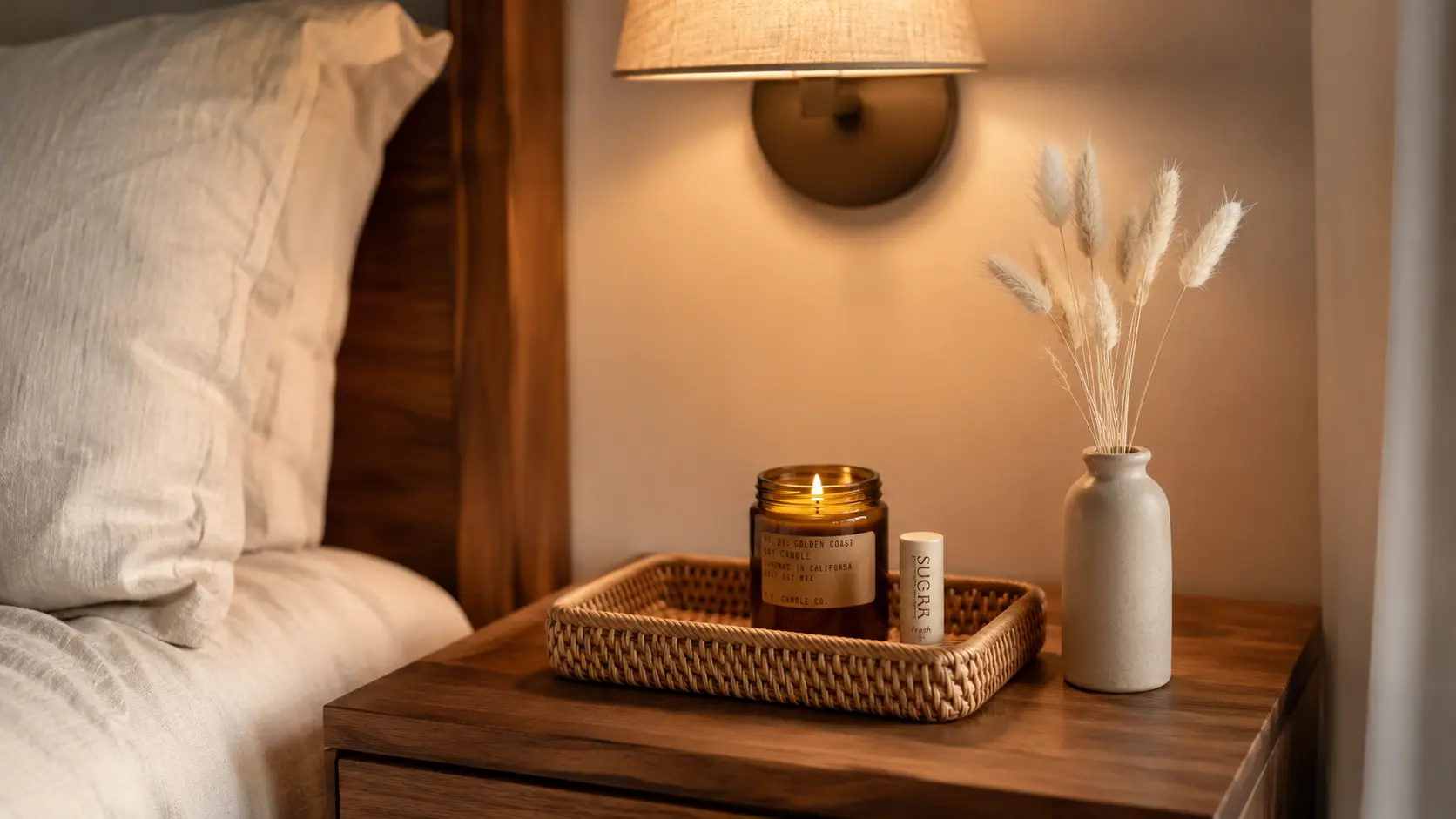
Step 1: Place the tray. The tray is the foundation, not the decoration. It draws a boundary around the surface and establishes the rule: if it lives inside the tray, it belongs. If it doesn’t fit inside the tray, it doesn’t belong on the nightstand. A 10-inch rattan or ceramic tray fits most standard nightstands — compact enough to leave breathing room on the surface, large enough to contain three or four small items without looking overfull.
Step 2: Add one object with height. Without a lamp, there’s no vertical anchor — so you create one intentionally. A narrow vase is the most natural choice. A small stack of two or three books works too. The height should sit somewhere between 8 and 12 inches — enough to create visual presence at eye level when you’re lying in bed, not so tall that it reads as dominating the space.
Step 3: Add one organic element. This is the thing that makes the surface feel inhabited rather than arranged. A handful of dried stems in the vase. A single small trailing plant in a pot. The organic element reads as low-effort warmth — exactly what the nightstand needs to feel personal rather than styled-for-photos.
Step 4: Contain the one functional item you can’t remove. The lotion lives inside the tray. The phone charger either routes behind the nightstand via a cord clip or disappears into a wireless charging pad tucked inside the tray. The book goes on the lower shelf if there is one, or flat under the tray if there isn’t. One visible functional item maximum, and it belongs inside the tray’s boundary. Everything else finds another home.

The Surface Formula That Holds
The bedside table decor ideas that hold long-term all follow the same logic. The four-piece formula — tray, height, organic element, one contained functional item — works because every object has a structural reason to be there, not just an aesthetic one. When the surface has a logic, it stays. When it doesn’t, it reverts. Here’s what each piece looks like in practice.
The tray. It defines the boundary. Everything inside it is intentional; everything that ends up outside it doesn’t belong. A rattan tray — hand-woven, natural fiber, compact — works on a wooden nightstand because the woven texture adds visual interest without competing with anything else. The S310 Small Rattan Serving Tray comes in a 10 × 5.1-inch size that’s specifically nightstand-scaled: large enough to contain three or four items, small enough to leave the rest of the surface breathing room. The natural rattan material is the right call for an Earth palette — it photographs warm without needing anything around it to make it look intentional.
The height. A narrow ceramic vase solves the vertical gap cleanly — and the TINCTOTNIC Ceramic Vase Set comes in three sizes with a distressed beige finish, the kind of chalky matte surface that reads as genuinely earthy rather than purely decorative. The smallest vase (4 inches high) is the right nightstand scale — it creates presence without overwhelming the tray. The other two work on a shelf, dresser, or windowsill without looking like overflow from the nightstand.
The organic element. Dried pampas stems are the most forgiving nightstand choice — no water, no dropping petals, no weekly maintenance. A small handful of 8 to 10 stems in the narrow vase creates the right density. The ANPROOR Dried Pampas Grass comes in white and brown tones that work naturally in a warm, earthy palette without needing to match anything else on the surface. The set contains 100 stems — use a small handful for the vase, rest them on a shelf or in a larger floor arrangement elsewhere in the room.
The warmth layer. A candle earns its place on the tray by adding a second sensory dimension without adding visual clutter. The Sweet Water Decor Warm and Cozy Soy Candle — amber jar, warm scent, soy wax — keeps the visual temperature of the surface consistent with the rattan and ceramic. The “Warm + Cozy” scent (orange peel, cinnamon, ginger) is the evergreen option in the line, not a seasonal one, so it reads as a permanent fixture rather than a December holdover.
💡 Why the formula holds: Each of the four pieces has a structural job — not just an aesthetic one. The tray defines the boundary. The vase creates the vertical anchor. The stems keep the surface alive. The candle adds warmth without function-creep. When every object earns its place structurally, the surface stops needing to be managed. You’re not maintaining a style. You’ve built a system.
The Cord Problem, Solved
The phone charger is the single most reliable destroyer of a styled nightstand. It appears every night, it’s attached to a cord, and it has to go somewhere. Every beautifully styled nightstand guide is quietly pretending this doesn’t exist.
There is one swap that eliminates the cord problem at the source: a rechargeable lamp replaces the corded one. No cord running off the nightstand edge, no cable snaking to the outlet. The lamp charges via USB-C when needed and can move off the surface when you don’t want it there — onto a lower shelf, a windowsill, or a side table nearby. When it sits on the nightstand, it’s a design object. When it doesn’t, the surface stays clear.
The Kakanuo Cordless Table Lamp Rechargeable — warm-toned base, white shade, 3000K light temperature — runs 9 to 16 hours on a full charge. At 15.8 inches tall it’s the right nightstand height: visible from the bed, warm enough to read by, compact enough not to dominate the surface it sits on. For the phone itself, a wireless charging pad inside the tray completes the cord-free setup — phone goes in the tray at night, charges without a visible cable, comes out in the morning.
If a rechargeable lamp is a bigger purchase than makes sense right now, a cord management clip attached to the back of the nightstand routes the existing charger cord behind the surface and out of sightline. It doesn’t fix the root cause, but it removes the visual chaos while you work toward the longer-term swap.
Where the Light Goes Instead
The assumption worth dismantling: the light has to live on the nightstand. It doesn’t. Warm, useful, reading-appropriate light can come from three other positions that work better for most bedrooms than the nightstand surface does.
Wall-mounted above the nightstand. A plug-in sconce positioned 24 to 30 inches above the nightstand surface puts light at exactly the right angle for reading in bed — eye level when sitting up, not below it. It frees the entire nightstand surface, the cord runs against the wall where it’s far less visible, and the sconce becomes part of the wall’s composition rather than competing with the nightstand below. For renters: plug-in sconces with the included adhesive hooks require no drilling and no landlord permission. The Yunaking Plug in Wall Sconces come as a set of two with a beige linen shade — warm tone, renter-safe installation built in.
On a lower shelf. If the nightstand has a lower shelf, the rechargeable lamp lives there. At shelf height it casts light upward into the room — more ambient, less direct, warmer in feeling — while keeping the top surface entirely clear for the four-piece formula.
Floor lamp in the corner behind the bed. A floor lamp in the corner behind the head of the bed throws light across the ceiling and wall rather than straight at the face. It’s the warmest light position in the bedroom and it asks nothing of the nightstand surface at all. If you’re working on the broader bedroom lighting system, this post on the small bedroom lighting fix covers the full three-layer approach that makes any bedroom feel finished rather than just lit.

Shop This Bedside Setup
The rattan tray and the cordless lamp are where the system starts — the tray defines the surface, the lamp frees it from the cord. Everything else layers in once those two decisions are made.
S310 Small
Rattan Tray
The boundary-setter. Once this goes on the nightstand, the rule is automatic: inside the tray is intentional, outside the tray doesn’t belong. Ten inches of hand-woven natural rattan — compact enough to leave the surface breathing room, grounded enough to anchor everything beside it.
Kakanuo
Cordless Lamp
No cord, no cord problem. This rechargeable lamp runs 9 to 16 hours on a single charge and moves wherever you need it — on the surface, on a lower shelf, or off the nightstand entirely. Warm 3000K light at 15.8 inches. The single swap that makes the nightstand sightline look as clean at midnight as it does at 7am.
TINCTOTNIC
Ceramic Vase Set
Three beige ceramic vases in a distressed matte finish — the smallest (4 inches) goes on the nightstand as the vertical anchor, the other two find their place on a shelf or dresser. The chalky surface reads earthy without trying. This is the height that fills the gap the lamp left, without needing a lamp to do it.
ANPROOR
Dried Pampas Grass
A small handful of stems in the vase — 8 to 10 is the right nightstand density. White and brown tones work in any warm palette without needing to coordinate with anything else on the surface. No water, no weekly care, no wilting. The 100-stem set means the rest of the arrangement lives on a shelf or in a floor vase elsewhere in the room.
Sweet Water
Soy Candle
The candle earns its place in the tray by adding a second sensory layer without taking up meaningful visual space. The amber jar disappears into an earthy palette. The “Warm + Cozy” scent — orange peel, cinnamon, ginger — is the evergreen option in the Sweet Water Decor line, which means it works in January and July without feeling out of place.
Frequently Asked Questions
What goes on a nightstand besides a lamp?
The bedside table decor ideas that work without a lamp follow a four-piece formula: a tray to contain and define the surface, one object with height (a narrow vase or a small stack of books), one organic element (dried stems or a small plant), and one contained functional item (lotion, a candle, or whatever you actually reach for before sleep). The lamp doesn’t have to be the fifth thing — it works just as well from a wall sconce above, a lower shelf, or a floor lamp positioned in the corner behind the bed.
How do I keep my nightstand from getting cluttered?
The tray is the system. Once it defines the surface boundary, the rule becomes automatic: if it doesn’t fit inside the tray, it doesn’t belong on the nightstand. Objects that migrate in — receipts, hair ties, glasses — get returned to where they actually live rather than settling permanently. The tray makes the decision for you so you don’t have to make it at 11pm.
Do nightstands need to match?
They don’t. Matching nightstands read as a furniture set rather than a considered room — which tends to make a bedroom feel like a showroom floor rather than a lived-in space. The better approach is a shared visual language: same material palette (both earthy, both warm-toned, both natural), same rough height, different specific objects. Cohesion comes from the palette, not the matching purchase.
What can I use instead of a nightstand lamp?
Three options that work for renters: a plug-in wall sconce above the nightstand (no drilling needed with adhesive hooks — renter-safe), a rechargeable lamp that lives on a lower shelf or moves off the surface when not needed, or a floor lamp in the corner behind the head of the bed that throws light across the ceiling rather than straight at you. All three free the nightstand surface and put the light where it’s most useful.
These bedside table decor ideas don’t require a full overhaul. It needs a boundary — and the tray is where that starts. Place it today, define the rule, and let the surface organize itself around it. The vase, the stems, the candle — those are the second layer. The tray is the one decision that makes all of them hold.
If you’re working on the rest of the room at the same time, the bedroom sanctuary post covers how to approach the whole space with the same remove-first logic — starting with what’s actively working against rest before adding anything new.
Leave a Reply