Disclosure: This post contains affiliate links. If you buy through them, I may earn a small commission at no extra cost to you. I only recommend products I’d genuinely put in my own space.
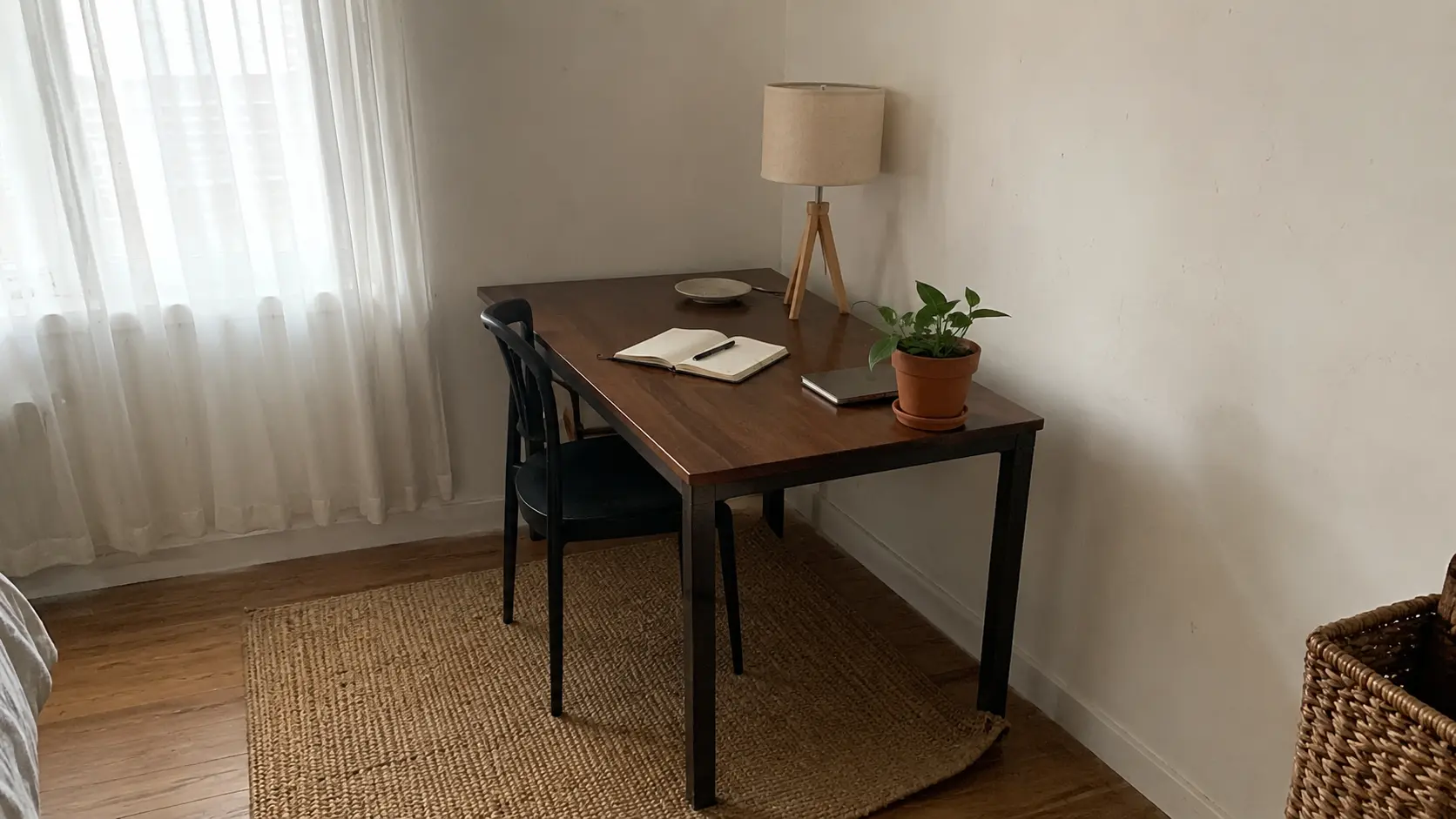
The plant is there. You bought it after reading an article that said greenery makes a workspace feel better. The candle is on the windowsill — the one that smells like sage and costs more than a candle probably should. There’s a throw draped over the back of the chair because you saw it on Pinterest and it looked exactly right. And yet every morning you sit down and the corner still feels like a cubicle. Not your cubicle — just a cubicle.
You’ve done all the things the articles said. You have the evidence: plant, candle, throw. The desk is decorated. It even photographs well. But sitting in it for eight hours still feels like being at work in a building that belongs to someone else, and the fact that you followed all the advice and still feel wrong is the most demoralising part of all. Here’s what none of those articles told you: the problem was never the plant.
Home office decor fails not because of what’s missing, but because the atmosphere itself — the light quality, the sense of belonging, the signal that the day has an end — was never fixed. This post diagnoses the three things that keep a rental desk corner feeling wrong, and gives you the no-drill, no-paint fixes that actually change the feeling, not just the look.
Why Your Home Office Decor Still Feels Like Work (Even After the Plant and the Candle)
If your workspace still feels off despite trying everything, it’s almost always one of three specific problems — and it’s rarely the one you’ve been attempting to fix.
The light is wrong. Not dim or bright — wrong in temperature. Overhead fixtures and most entry-level desk lamps run cool and blue-white, above 4,000 Kelvin. That colour temperature signals alertness. It also makes any space feel clinical, impersonal, and impossible to settle into — the same spectrum used in hospitals and open-plan offices. If you sit down every morning and the corner immediately reads as “work mode” before you’ve done anything, the overhead light is almost certainly why.
There’s no personal layer. Every home office decor article tells you to add things — a plant, some art, a nice mug. What they don’t tell you is that those objects only shift the feeling of a space when they carry meaning specific to you. A bestseller-list print and a succulent bought because an article said to buy one aren’t a personal layer. They’re decoration. A personal layer is the stack of books you actually read, the ceramic dish a friend made, the photo from somewhere that mattered. The difference between a styled corner and a personal one is whether it could belong to anyone — or whether it clearly belongs to you.

Nothing signals when work is over. This is the least obvious problem and the most damaging. In a traditional office, leaving is the signal — the commute, the building door, the walk to the car. Your nervous system uses that transition whether you want it to or not. When your desk is three feet from your bed, there is no transition. The corner is always visible, always present, always on. And a space that never closes stays open in your head all evening, even when you’ve stepped away from it.
💡 The three-symptom check: Cold overhead light + no objects that are specifically yours + no signal that the day has ended = a corner that will keep feeling like work indefinitely, regardless of how much you add to it. All three need fixing. Addressing only one leaves the other two doing their damage quietly.
The Object Isn’t the Problem. The Feeling Is.
Most home office decor advice works on a simple assumption: the space feels wrong because something is missing. Add a plant. Add art. Add a lamp. Eventually, if you add enough of the right things, the space will feel right. It doesn’t work. You’ve probably already tested this theory.
The reason isn’t that the individual pieces of advice are wrong — warm lamps and plants and natural materials genuinely help. The reason is that the advice confuses the symptom with the cause. A workspace that still reads as a borrowed corporate space after months of adding things doesn’t feel that way because it lacks objects. It feels that way because the atmosphere is broken at the source. The light reads institutional. The setup looks assembled by someone trying to be productive, not trying to feel at home. No amount of additional objects fixes that, because you’re trying to solve an atmosphere problem with a shopping problem.
You can’t decorate your way to a different feeling. You have to fix the conditions that produce the feeling.
What actually changes how a workspace feels isn’t a new object — it’s a shift in the sensory environment. The quality of the light. The presence of warm natural materials that carry their own warmth even without styling. A clear signal that the space has a beginning and, more importantly, an end. Those aren’t product categories. They’re atmospheric conditions. And every one of them is achievable in a rental corner, without drilling, without painting, and without a complete overhaul of what you own.
Home Office Decor Ideas That Work Without Touching the Walls
Here is the version of “make it personal” that actually works for renters — not because it works around the landlord-white walls, but because it makes those walls irrelevant.
Trying to fight the rented wall — hanging art, adding removable wallpaper, drawing attention to the wall itself — usually makes things worse. You’ve highlighted the rental’s most visible constraint and it still looks like a rental. The better move is to make the desk corner so visually coherent in its own palette — warm, textured, natural — that the beige wall recedes entirely. You stop seeing the wall because you’re seeing the corner instead.
Scent before anything else. Before changing a single visual element, change what the space smells like when you sit down. Scent is processed by the same part of the brain that handles emotion and memory — which means it’s the fastest atmospheric anchor available and the one that bypasses visual judgment entirely. Lighting a candle at the start of work creates a sensory cue that compounds over time: this smell means I’m here, and I like being here. The MOULENGGU 6-Pack Soy Wax Candles come in six earthy scents — sage breeze, lavender, coconut vanilla among them — in clear glass jars that sit on a desk without reading as clutter.
One warm textile. A throw draped over the back of the chair does something that sounds almost too small to count: it makes the chair look chosen instead of assigned. If the desk chair is the one element still reading as “task furniture,” a linen or cotton throw in a warm neutral changes its register — from office equipment to a place someone actually wants to sit. This costs nothing if you already own a throw.
Natural material on the desk surface. A small wooden tray, a rattan catch-all, a ceramic dish — one object that introduces natural texture into the visual field between you and the monitor. Chrome and plastic are the visual vocabulary of corporate spaces. Natural materials are the visual vocabulary of home. One piece that breaks the plastic-and-chrome pattern is enough to shift what the desk communicates about where you are.
Personal, not styled. One object that could only be yours. Not chosen for the aesthetic — chosen because it means something. A mug from somewhere you went, a card from someone you know, a print from a market. A styled desk could belong to a stranger. A personal desk could only belong to you. The belonging comes before the styling, not after.
💡 The renter identity rule: In a rental, you can’t touch the walls and you can’t change the floor. That means the desk surface and the objects on it are carrying almost all the “this is mine” weight in your home office. Treat the desk surface seriously — it’s doing more atmospheric work than any other element in the corner.
The Home Office Decor Idea That Makes the Biggest Difference: Light
Light has a colour temperature measured in Kelvin. Below 3,000K, light is warm and amber — the register of evenings, of winding down, of being home. Above 4,500K, light is cool and blue-white — the register of offices and hospitals, of being switched on and alert. Your overhead ceiling fixture is almost certainly above 4,000K. Which means every morning when you sit beneath it, your nervous system is receiving a quiet, persistent signal: this is a place for work, not for being at home.
The fix isn’t to work in the dark. It’s to add a warm-toned table lamp to the corner and switch off the overhead while you work, using the lamp as the primary light source instead. When you replace a cool overhead (directional, institutional, 4,500K+) with a warm table lamp (2,700–3,000K, diffused, soft), the corner immediately reads as a room in a home rather than a workstation in a building. Same desk. Same chair. Same walls. Completely different atmosphere — because the light changed what the space was signalling.

The EDISHINE Tripod Table Lamp has a light brown wood tripod base and a linen shade that scatters light diffusely rather than directing it at the desk — so the corner gets warmth, not a spotlight. At 14.2 inches tall it sits at the right scale for a desk surface or nearby shelf: close enough to warm the field of view, not so tall it dominates a small corner. The linen shade reads warm even switched off, which matters for the visual atmosphere of the corner when you’re not working — it’s still telling the space it belongs in a home, not an office. No installation required; it plugs in.
In the evening, when the day ends, switch off the overhead and switch on the lamp alone. The change in light quality is immediate — the corner stops reading as a workstation and starts reading as part of the room you live in. That day-to-evening shift is also the physical mechanism for the most important thing a rental home office needs: a closing signal. Which is what the next section is actually about.
The Real Reason Your Home Office Makes It Hard to Switch Off (It’s Not Discipline)
The myth: if you work from home and the workday won’t end in your head, it’s a focus or willpower problem. You need better systems, a stricter routine, more discipline.
The truth: it’s an atmosphere problem. And it’s not your fault.
Before remote work, the office building did something important that had nothing to do with productivity: it was a container. You went in. Work happened inside. You left. The physical act of leaving triggered a genuine neurological shift — a reduction in cortisol, a parasympathetic transition, the signal that you were off duty. Commutes were often grim, but they were also involuntary decompression. Your nervous system used that transition even when you hated it.
When the desk is in your bedroom or your living room, there is no container and no transition. The corner is always visible. The laptop is always there. The to-do list exists in the same four walls where you try to rest. Your brain never receives a clear “work is over” signal — and without that signal, it stays switched on. The evening drifts. You drift back to the screen. Not because you lack discipline. Because nothing in your environment told you that stopping was allowed.
The fix isn’t a productivity system. It’s a closing ritual — a deliberate five-minute sequence that physically changes the corner enough that the brain registers: this space is now something different.
The five-step shutdown ritual:
1. Close the laptop and move it out of sightline from wherever you rest.
2. Drape the throw over the chair back, covering where you sit for work.
3. Switch off the overhead. Switch on the warm lamp only.
4. Move one object on the desk — candle forward, notebook closed, mug to the kitchen. The arrangement changes; the “mid-task” reading disappears.
5. Light a candle, open a window, or do one thing that carries a distinct sensory signal: the day is over, and you are home now.

A freestanding room divider makes the shutdown ritual complete by doing what a rental cannot otherwise do: it lets you physically close the corner. The FDW 4-Panel Room Divider has a natural rattan weave and stands 71 inches tall — enough to block a desk corner completely when folded closed. During work hours it frames the space, open on both sides. After the shutdown ritual it folds closed, and the desk disappears. For a desk in a bedroom or studio, that visual disappearance changes how the rest of the room feels to be in — the sleep or rest space stops sharing a sightline with the work space. Freestanding, no drilling, no wall contact.
💡 If your desk is in the bedroom specifically, the closing ritual matters more than any decorative change on this list — because the bedroom carries its own psychological weight as a rest space. For more on creating a bedroom that actually signals rest instead of work, the bedroom sanctuary post covers the principles here. The home office lighting approach also connects directly to what that post calls the 10pm test.
One Home Office Decor Rule That Changes the Corner Completely: The Rug
A rug under a desk does something that sounds almost too small to be true: it tells the corner it has edges.
Without a rug, a desk pushed into a room corner is just furniture against a wall. With a rug — specifically, a rug that extends under the front two desk legs and out in front of where the chair sits — the corner becomes a zone. The floor makes a claim: this space has a boundary, it starts here, it has its own internal logic. That sense of enclosure, however subtle, is what makes a small desk corner feel like a room within a room rather than a place where a desk happened to end up. The desk stop floating; the corner starts belonging.
Sizing is the most common error, and it almost always goes in the same direction: too small. A 3×5 rug under a standard desk looks apologetic — like something placed to cover a mark on the floor. It makes the corner feel smaller, not more defined. For a standard desk corner, the right size is a 4×6: front two desk legs resting on the rug, the chair in front of the desk also on the rug when seated. The desk doesn’t need to sit fully on the rug — just enough for the two to be visually anchored together.
For tone, warm neutral in this spot. The desk corner is already carrying visual weight — the monitor, the lamp, the books. A bold or patterned rug competes. A warm jute or natural-fibre rug in a neutral undyed tone adds presence without noise and photographs as considerably more expensive than it costs, because natural fibre textures read as high-quality in any light.

📸 IMAGE 5 — TEXTURE MACRO | Upload image then delete this block.
Alt text: SAFAVIEH natural jute rug texture close-up — handwoven natural fibre area rug for home office desk corner
Caption: Jute has a texture that gets better every year — it softens slightly with use and never looks synthetic under a warm lamp.
Prompt: Snapshot taken on a phone in a real rented apartment — an extreme macro close-up of natural jute rug texture. The jute rope weave fills 80–90% of the frame. Warm undyed natural tan colour — individual strands visible, slight natural colour variation between strands, some warmer brown, some slightly lighter. Low-angle raking light entering from the left side, creating micro-shadows within the weave that reveal the depth and texture of each rope strand. One jute strand in the weave is slightly thicker and raised from the surface compared to those around it — a natural variation in the handmade weave. At the very bottom edge of the frame, a blurred desk leg in light wood or white rests on the rug surface — just visible, entirely soft focus, confirming this is a real rug in a real space. DSLR photograph, 90–100mm macro lens, f/2.2. No room context. The material is the entire frame. Real rental apartment context implied by the desk leg. Not a studio product shot. Imperfect natural material, authentically photographed.
📎 Attach product reference images: Please attach the following Amazon product screenshots when generating this image: SAFAVIEH Natural Fiber Collection Jute Rug NF447A in Natural — main listing image. I am attaching the SAFAVIEH jute rug as reference image 1. Reproduce the natural undyed jute texture, rope weave pattern, and warm tan-brown colour accurately. Do not substitute a different rug or a synthetic-looking texture.
The SAFAVIEH Natural Fiber Collection Jute Area Rug (NF447A, 4×6, Natural) is handmade from genuine jute — confirmed natural fibre, not synthetic, not faux. The Natural colourway is an undyed warm tan that sits underneath a wood-based desk setup without competing for attention. With over 5,900 reviews and an Overall Pick designation, it carries the kind of review depth that removes the guesswork about what a jute rug actually looks and feels like when it arrives. Note the “Low Returns” signal on this listing — jute rugs frequently attract returns for shedding complaints, and SAFAVIEH Natural Fiber consistently bucks that trend. Position the front two desk legs on the rug, chair in front, and the corner becomes a defined zone.
If you want to take the spatial layer further — in a studio apartment where the desk shares a room with everything else — the approach from the home office for small spaces post covers how the anchor-light-texture sequence works when the zone also needs to function as a second room.

Shop This Home Office Corner
Start with the lamp — it changes the atmospheric condition of the corner faster than anything else, and costs the least. The rug and the divider follow; the candles can come from anything you already own.
EDISHINE Tripod
Table Lamp
Light brown wood tripod base, linen shade, 14.2 inches. Switch off the overhead and use this as the only light source while you work — the corner stops reading as an office and starts reading as a home. Try it tonight before you buy anything else.
SAFAVIEH Jute Rug
4×6 — Natural
Handmade natural jute, warm undyed tone. Front two desk legs on the rug, chair in front — the corner becomes a defined zone in under sixty seconds. Over 5,900 reviews and a Low Returns signal: the rug that actually looks like jute when it arrives.
FDW 4-Panel
Room Divider
Natural rattan weave, 71 inches tall, freestanding. Open during work hours, closed after the shutdown ritual — and the desk vanishes entirely. The only way to give a rental corner a door without touching a wall.
MOULENGGU Soy
Candle Set — 6 Pack
Six 3.5oz soy wax candles — sage breeze, lavender, coconut vanilla among the scents. Light one when you start. Light a different one in the shutdown ritual. Over time, the scents become the signals. Clear glass jars, lead-free, $21.99 for six.
People Also Ask
What makes a home office feel professional but still cosy?
The word “professional” in a home office is doing damage — it usually means “corporate,” which is the exact register that makes a rented corner feel wrong. Aim instead for “focused and warm”: a space that helps you think clearly and that you also want to be inside. Warm light, natural materials, one personal object, and an uncluttered desk surface produce that combination more reliably than anything marketed as “professional office decor.”
What’s the most important home office decor change for renters?
Lighting. It’s the fastest, most affordable, and most immediately noticeable atmospheric shift available. One warm-toned table lamp used instead of an overhead fixture changes the feel of a corner more in five minutes than redecorating changes it in a week. If you do nothing else from this post, switch off the overhead tonight and use whatever warm lamp you already own in its place.
Can a desk in the bedroom work for long-term WFH?
Yes — with the right setup. The rug zone defines the desk corner as its own space. The room divider closes it off at the end of the day. The shutdown ritual changes the atmosphere deliberately. None of these require a permanent change to the room or the rental. The bedroom and the work space can coexist in the same room; the key is that one of them closes at 5pm.
How do I stop my home office looking like a corner I forgot to decorate?
The “forgot to decorate” feeling almost always comes from floating — a desk with nothing anchoring it to the floor and nothing framing it from the sides. A rug under the front desk legs anchors it to the floor. A room divider or even a tall plant to one side gives it a lateral boundary. Once the corner has edges, it stops looking accidental and starts looking deliberate — regardless of what’s on the desk surface.
A workspace that still feels wrong after you’ve done everything isn’t a decorating failure. It’s an atmosphere problem — and atmosphere, unlike furniture, can be changed in five minutes without touching a single wall.
The lamp is where to start. Switch off the overhead tonight and use whatever warm lamp you own. That one change is enough to know whether this approach is right for your corner — and it costs nothing to find out.
Leave a Reply