As an Amazon Associate, I earn from qualifying purchases. This post may contain affiliate links, which means I may earn a small commission at no extra cost to you.
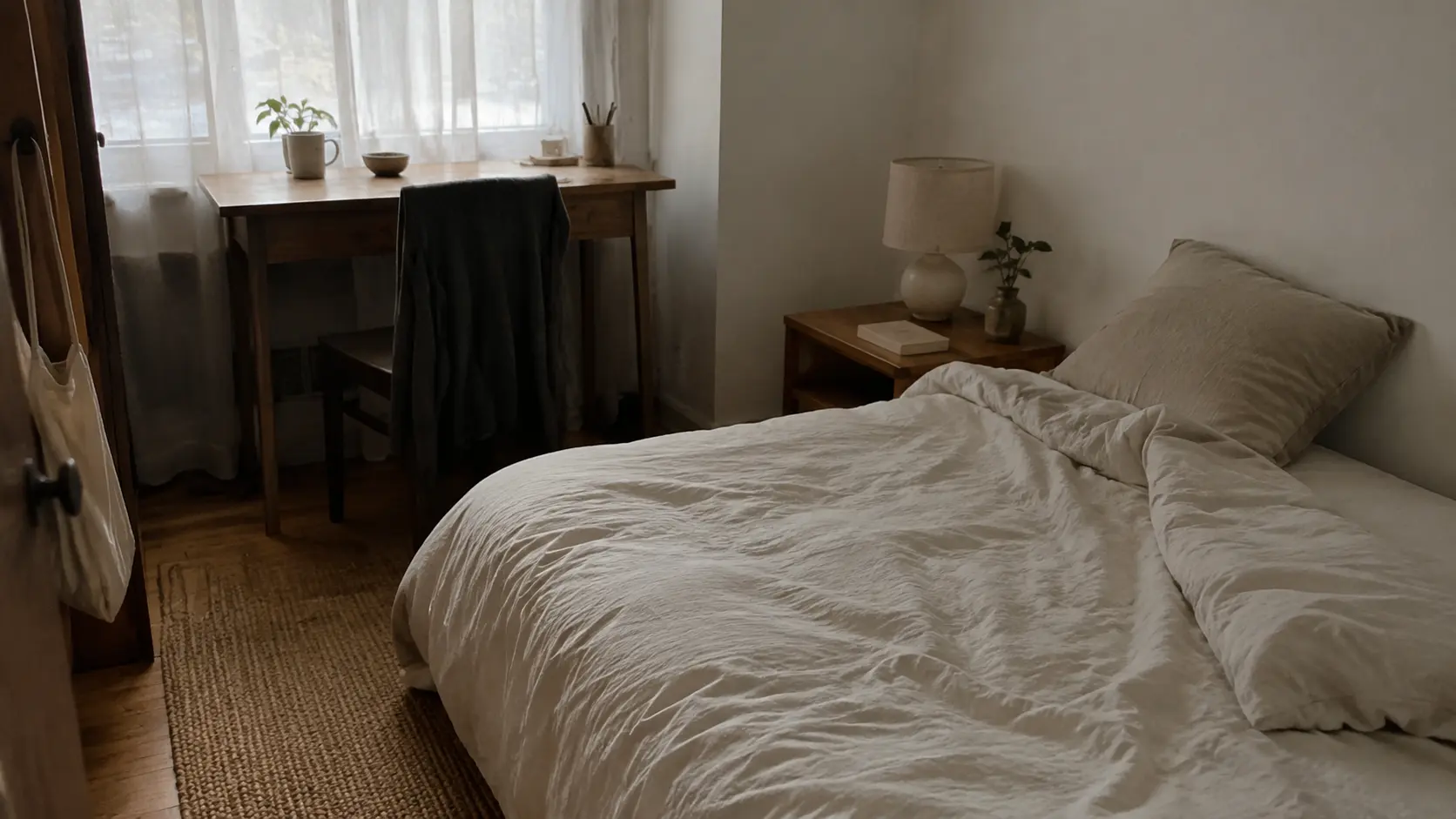
Your desk is wedged into the corner of your bedroom, maybe six feet from where you sleep. At five o’clock you close the laptop and cross that distance to lie down — except some part of you doesn’t stop. The lamp’s still on. The notepad’s still open. Your eyes land on the desk before the ceiling, and you’re still half-drafting tomorrow’s first email.
Most desk setup ideas for small spaces stop at “turn it toward the wall” or “hang a curtain” — you’ve likely already tried the standard advice, and it never held past the second week. That’s not a willpower problem. It’s a signal problem. A brain doesn’t downshift from one visual cue. It needs several signals arriving in the same few minutes, in a specific order, before it believes the workday actually ended.
These desk setup ideas for small spaces aren’t a list to pick from — they’re a sequence: five moves, done in order, that turn a bedroom desk from a standing reminder into furniture that’s simply finished for the day.
The 5-Step Switch-Off System
✓ Step 1 — Position: Check the view from your pillow, not your chair
✓ Step 2 — Light: Task light off, warm rest light on — two sources, never simultaneously
✓ Step 3 — Divide: A physical break between the desk and the bed
✓ Step 4 — Surface: Put the desk in its closed state — not just tidy, closed
✓ Step 5 — Anchor: One sensory object with zero connection to work
Step 1: Position — The Only Sightline That Actually Matters
Start with where the desk sits, not where a decorating checklist says it should. The common fix — angling the chair so the desk faces the wall — helps, a little, for as long as you’re sitting in it.
It stops helping the second you lie down.
The desk-facing-the-wall trick optimizes for the view from the chair. But the sightline that actually decides whether your bedroom feels like a bedroom is the one from your pillow. If you can see the desk from bed — even just the corner of it, even in low light — no amount of chair-angle adjustment turns off the low-level signal your brain keeps receiving all night: there’s still work in this room.

This is the same logic behind the sightline test used for placing the bed itself — where you put the bed changes how the whole room reads, and the same test applies to everything else sharing the space with it. Before touching lighting or dividers, check what’s actually visible from where your head hits the pillow. If the desk is in that sightline, everything in Steps 2 through 5 is working against a view you haven’t corrected yet.
Your body doesn’t clock out because you told it to. It clocks out because the room stopped arguing with you.
Step 2: Two Lights, Two Modes
Here’s the visual problem most bedroom-desk setups share: one light source is doing two jobs. The same overhead fixture or desk lamp that lights your spreadsheet at 2pm is still the brightest thing in the room at 9pm — so the room never actually looks like nighttime, it just looks like daytime with less traffic.
A bedroom that’s supposed to switch modes needs two distinct light sources that never run at the same time. One is task light — bright, positioned at the desk, only on while you’re working. The other is rest light — warm, low, positioned away from the desk entirely — and it’s the one that turns on the moment the first one goes off.

The EDISHINE Tripod Table Lamp earns its spot here because it does one job completely: a linen shade over a light-brown wood tripod base that reads as furniture, not equipment — nothing about it looks like it belongs on a desk. Set it on a nightstand or low shelf on the opposite side of the room from the desk, and switching it on becomes its own small ritual. There’s a real difference between flipping an overhead switch and reaching for a warm lamp across the room — the second one feels like a decision, not a reflex, and that small deliberateness is what tells your body the day actually changed shape. By the time it’s glowing and the desk lamp is off, the room has already started to feel like a bedroom again, before you’ve touched anything else.

Step 3: The Divide — Visual Break Without a Drill
Even with the sightline corrected and the lighting split, a desk sitting in open view still reads as a workstation the moment you glance at it. What the corner needs next is a physical break between where you work and where you sleep — something your eyes hit before they reach the desk.
You have three ways to do this, and they’re not interchangeable. A tension-rod curtain is the cheapest and fastest, but it only blocks the view when it’s actually drawn — which means it depends on you remembering to close it every evening. A tall bookshelf gives you storage along with the break, but it needs floor depth most small bedrooms don’t have spare. A freestanding folding screen sits between the two: no rod to install, no floor depth to sacrifice, and it stays closed on its own without you touching it every night.
For most small bedrooms, the folding screen wins on the criteria that actually matter here — cost, effectiveness, and footprint. The FDW 4-Panel Room Divider is a natural rattan weave that folds flat against a wall when you want the desk visible during work hours, and unfolds in one motion when the day’s over. No drilling, no landlord conversation, no deposit risk — it’s furniture, not a fixture.


Step 4: Surface State — Not “Tidy,” Closed
This is the step that actually explains why the first three didn’t fully work on their own, and it’s the one most people skip because it sounds too small to matter.
The desk doesn’t need to be tidy at the end of the day. It needs to be closed — and those are different states. A tidy desk still has your laptop sitting there, your notebook flat and readable, your pen resting where you left it mid-thought. A closed desk has one fixed position everything goes into, so ending the day becomes one motion instead of a decision you have to make fresh every single night.
That’s a math problem, not a discipline one. If closing the desk requires deciding where five separate objects go, you’ll skip it on the nights you’re tired — which is most nights. If it requires putting five objects into one tray, in the same spot, it takes ten seconds and no decision at all.
A shallow bamboo tray does this job better than almost anything else on a desk this size. The Lipper International Bamboo Organizer Tray has four compartments — just enough to hold a charger, a pen, a notepad, and one small object, without becoming another surface that collects clutter of its own. It sits in the same corner every night. Nothing about closing the desk requires a decision anymore; it just requires reaching for the tray.
💡 The tidy/closed distinction. A desk you have to decide how to close, you’ll eventually stop closing. A desk with one fixed “off” position closes itself.
This is the same principle behind treating a home office as somewhere that needs a genuine closing signal, not just a decor refresh — the feeling doesn’t change until something in the room signals, physically, that the day is over.

Step 5: The Anchor Object
The first four steps are entirely functional — position, light, divide, closed surface. None of them give the corner anything to feel like yours once the desk disappears from the equation. That’s the job of the fifth step, and it’s the one people usually add first, which is why it doesn’t work in isolation.
Once the desk is closed and the divider’s up, the corner needs one object that has nothing to do with productivity at all — something purely sensory, chosen because you like it, not because it organizes anything. A chunky knit throw draped over the chair or the end of the bed does this well: it’s the opposite texture of a laptop, and touching it registers, physically, as not work.
The Longhui Chunky Cable Knit Throw works for this specifically because of its weight — a 100% cotton knit heavy enough to stay draped rather than sliding off, in a beige that won’t compete with anything else in the room. Its only job is to give your hands something to do at the end of the sequence that has zero connection to the desk.
If task-signal removal sounds familiar, it’s the same idea behind clearing anxiety-triggering objects from the rest of the bedroom — every object in the room is either signaling rest or signaling task, and the fifth step is the one that finally tips the balance toward rest.

None of these five moves require a weekend project or a trip to a hardware store you don’t have a key to. Do them in order, once, and the corner stops being a place you avoid looking at after six. It just becomes the corner where your desk happens to be — closed, quiet, and done for the day.
Shop the 5-Step Switch-Off Setup
Start with the lamp — it’s the single move that does the most to separate work-mode from rest-mode, and everything else in the sequence builds on it.
EDISHINE Tripod Table Lamp
The rest-light half of Step 2. Linen shade, light-brown wood tripod base — reads as furniture, not equipment.
FDW 4-Panel Room Divider
Natural rattan weave. Folds flat during the day, unfolds in one motion by evening. Fully freestanding.
Lipper Bamboo Organizer Tray
Four compartments, one fixed spot. The entire “closed vs. tidy” step in one small object.
Longhui Chunky Knit Throw
100% cotton, heavy enough to stay draped. The one object in the sequence with zero connection to work.
Frequently Asked Questions
Can you put a desk in a bedroom?
Yes — and for renters without a dedicated office, it’s often the only option. The key is treating the desk as a zone that switches off at the end of the day, not a permanent feature of the room. The 5-step sequence in this post is designed specifically for this situation.
How do I separate work and sleep in a small room?
Through accumulated sensory signals, not a single change. Position the desk out of your bed’s sightline, use two separate light sources for work and rest, add a physical visual break between the two zones, and establish a clear closed state for the desk at the end of each day. One change alone rarely holds — the sequence is what makes it stick.
How do I stop thinking about work when I am in my bedroom?
The most common reason this happens is that the room never visually changes between work hours and rest hours — so your brain never receives a clear signal that the day ended. Switching off the desk lamp and turning on a warm rest lamp is the fastest single change you can make.
Start tonight with one thing: switch off your desk lamp and turn on a warm bedside lamp instead. If that one change feels different after a few evenings, move to Step 2.
Where should a desk face in a small bedroom?
The standard advice is to face the desk toward a wall — that is a good starting point. But the more important check is the view from your bed, not from your chair. If you can see the desk from your pillow, it will continue signalling work all night regardless of which direction the chair faces.
How do I hide a desk in a bedroom without drilling?
A freestanding folding screen is the most effective no-drill option — it creates a physical visual break between the desk and the rest of the room, requires no wall anchoring, and folds flat when not needed. Tension-rod curtains also work but require you to draw them each evening. A tall freestanding bookshelf doubles as storage, though it needs more floor depth than most small bedrooms have spare.
Leave a Reply